Aangemeld als:
filler@godaddy.com

This page collates all of my ~3000 character yearly LinkedIn market roundups, with storyline-relevant data, behaviour, and trends observed in each country.
Each report offers a what-and-why of lagging data: what happened in that market and the trends behind it. You're welcome to use this page as a starting point for your own market research.
These semi-detailed reports are not intended as a copy/paste for a board-level view. Strategy and forward planning need What Now and What Next, informed by both market insights and data.

Behind these reports sits a large proprietary dataset. As a member of European Cycling Industries, I compile year-on-year trends across the EU, cross-referencing national industry association figures against Eurostat and national economic institute data; filterable by category and subcategory. The published roundups draw on a slice of it, adding insight and discernment to support each story.
A conversation with me adds decision-grade insight: what the data means for your product, price point, channel, timing, and risk. Structured industry data, filtered and interpreted, with field knowledge, commercial context or leading data added where the numbers are incomplete, unclear, or unpublished. It simplifies and refines accurately to support board-level clarity.
Drop me a line to discuss the data behind a market, the methodology and assumptions, or what it means for your next decision. I support brands on GTM planning, product portfolio design, positioning, market entry, pricing, channel strategy, inventory risk, forecasting, logistics, and more.

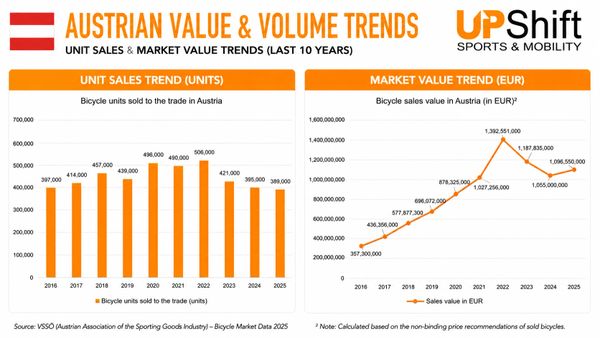
🇦🇹 AUSTRIA BICYCLE MARKET 2025 📊 ~389k units -1.7% | €1.097B val +3.9% | Record ASP €2,821, +5.7% | 5th consecutive €1B+ year, 57%⚡. A market stabilising into a new normal for quality dealers.
A deep restructure since 19 at -11.4% units, 39%⚡, €1585 ASP, +56.7% value.
💶 MACRO BACKDROP: GDP -0.3% in 2025 — Austria's 3rd consecutive contraction & longest recession in 45 yrs (-1% '23, -1.2% '24). Unemployment 5.6%, inflation 3.2%, consumer confidence -ve YoY for most of the year. Rev +3.9% in this context is a strong countercyclical signal. The bicycle has become a valued utility purchase.
THE LONG ARC: €700M in 19 to €1B today delivered a notable val rise on a moderate vol contraction. Premiumization is clear.
🔴 '25 LOSERS
- eFolding: -25% 3k units, Non-e folding -57% 3k; tot 6k units vs 8,4k in '24. Railcard holder subsidy expiry = demand evaporation.
- eCargo: -5% overall 7,1k units / Family: -25% 3,9k, subsidy ending / Goods transport: +37% 3,2k B2B subsidies intact.
- eMTB Hardtail: -11.4% 28,3k & MTB classic -36%: The entry level is contracting & saturated. Is the funnel empty, or deferred?
🟡 HOLDERS
eMTB Full-sus: 55,085 units (+0.9%) — Austria's alpine recreation baseline, driven by mild to strong enthusiasts
🟢 WINNERS
- Trekking/SUV-eBike: 101k units (+18%) for general market & mobility crossing 100k units; a strong alpine market product (consumers in other countries might substitute with city bikes / MTB’s).
- Gravel 28,8k (+48.3%); non-electric +74%. 5x in 5 yrs, for 57% of the dropbar market, all while "stealing" some of MTB's historic entry-level dominance.
- Road 12.3k +17.6%, enthusiastic quality defying the recession.
- Kids 63,7k +9%. Sub-20" +16%. But no Woom- factor; contracting ASP.
- Company leasing (6x vs 22) is a recession-resistant lever, but regionalised.
🔋 EU's eBIKE LEADER AGAIN: 57.3% overall (69% adult) for 79% of total rev at €867M, (ASP €3,891. +7.5%). Vs: DE 53%, BE 51%, CH 41%, NL 49%. An alpine geography sees this segment continue to deliver and grow.
🏛️ POLICY = RISK: where subsidies held, segments grew; where they lapsed, declines were immediate and sharp (Just like we saw in FR this year).
🔑BOTTOM LINE Stocks have re-normalised; discounting is ending. Cross-border liquidations from DE have also ceased (seen in BE & NL in 25 too), but margin pressure remains. Shops with quality workshops are finding the same new value center as elsewhere. AT's bike market is a portfolio in bifurcation: lifestyle/hobby driven & policy-supported segments pulled away from the legacy & subsidy-exposed. With premiumization through the worst recession in 45 years, we could see strength or risk.
Sources: VSSO, economic metrics, my knowledge.
The VSSÖ - Association of sporting goods producers and sporting goods dealers in Austria published their 2024 data this April. The bicycle market experienced a 6.1% decline in unit sales, totaling 395,426 units. Despite this, the market maintained a robust revenue of €1.055 billion, marking the fourth consecutive year surpassing the €1 billion threshold. With '19 at ~€700M, this reflects a 8.6% relative CAGR to '24: overall that gives a +50.7% reset. I believe that is Europe's #1 pre/post covid figure so far (!)
As usual I've added my own insights to this post. That said, this Bike Europe article makes a good expanded read.
📌 Key figures
- Total Bicycle Sales: 395,426 units sold, a 6.1% decrease from 2023.
- Market Revenue: €1.055 billion, down 11.1% year-over-year, yet exceeding €1 billion for the fourth consecutive year.
- eBikes accounted for 57.2% of all bicycle sales, up from 52.3% in 2023, the highest in Europe, contributing 77% of total market revenue.
Growth in Specific Segments:
E-folding bikes: +33.8% (+143% on pre subsidy '22)
E-cargo bikes: +48.7% (+58% on 22)
Gravel bikes: +12.7%
Road bikes: +20.8%
Average Selling Price (ASP): The average bicycle price decreased slightly to €2,668 from €2,820 in 2023, likely due to promotional discounts amid high inventory levels.
Government Incentives: Subsidies for e-cargo and ongoing special support for purchase of folding e-bikes for train commuters, played a pivotal role in the growth of eBike sales. The significant rise in e-bike sales, particularly in urban areas, underscores a national trend towards sustainable and efficient transportation solutions. The two together are really working magic in this transition.
While overall sales experienced a slight downturn, the market's ability to sustain over €1 billion in revenue indicates underlying strength. The growth in high-quality segments like gravel and road bikes suggests a healthy market among enthusiasts, possibly driven by lifestyle changes and increased health awareness. This trend mirrors behaviors observed in other countries, such as Spain.
But it's not all bad news: This is the third €1B year in a row, compared to 2019's 439k units & €700M value, with an expectancy of market recovery this year or early 25. eBikes led sales, attaining a "mobility milestone" of 52% (221k) of all units and 75% of cash (€894M) in till. They even accounted for 62% of adult bike units. Folding +39%, Gravel +20% and Road +10% categories performed best YoY, also following the well established less volume more value trend.
Folding (~8000 units, ~2% tot) and eCargo (~5500units, ~1% tot) were the fastest growing segments. This is a success which the VSSÖ - Association of sporting goods producers and sporting goods dealers in Austria atributes in part to subsidy and company bike programs, as well as their ease of use, low running costs, and low environmental impact.
Folding bikes are more than just an e-phenomenon. Quality is important to Austrian buyers as they are sell at an ASP of over €1900 muscular, €2500 electric, surely also aided by €500 subsidy. 2022's bike/train commute push from Austria is clearly having an impact as it is this portability that counts most to train commuters; likely why muscular bikes led with 68% of units in the segment. Overall, demand for folding bikes more than doubled at +108%, but again, numbers remain small at just ~8000 units. This is a space to watch for 24.
By contrast, just 470 or ~8% of 5500 cargobikes were muscular, with an overall ASP of a notable ~€5600. The cargo segment is expected to grow further in 24, and luckily the government has now scrapped a €150 eBike shop contribution to the subsidy value, of €900 per unit.
The bullwhip has also moved mostly upstream: Whereas 2022 and 2023 saw most stock and issues in retail, shops now seem to have restored balance and are playing safe, benefitting from close to market (excessive) manufaurer stock. Effectively relegating most overstock issues to suppliers and distributors, who are feeling the most pressure. Nonetheless consumer demand is ongoing and healthy, says the VSSÖ.
As usual my roundup sources from the report and personal experience
Belgium 2025: €869M new bike sales with a +7% YoY sell-in, +6.14 sell-out volume — where e-bikes took 50.92% of units (294,000) *but* an astounding 87.94% of the value (€793.8M), vs muscular at 49.08% (283,400)of the units for just 12.06% value (€109.1M). (Note: Belgian data lacks P&A, workshop or such values)
While most of the EU remains weighed down by stock weariness and cautious demand, Belgium turned a corner in 2025. The correction is done. The reason is structural: government leasing incentives and employer programs have created near-insatiable demand for high-quality bikes as vehicles, not just leisure items. This is overwhelmingly a Flanders story — Velofollies in Kortrijk drew 40k visitors radiating a confidence that is uniquely Flemish. Wallonia participates primarily in sport, representing only a few percent of market value.
📈 Confirmed Rebound578,737 new units (+7.1% Traxio / +7.7% GfK-NIQ) · ~200,000 second-hand 295,360 e-bikes (+7.45%) · 283,377 mechanical (+6.7%) Just 1 in 4 bikes sold is a sport bike.
🔢 Segment Evolution578,737 total
· 295,360 e-bike (51%) / · 283,377 mechanical (49%)
— Dropbar: Road: 57,771 (+14%) · Gravel/CX: 23,619 (+10%) · E-Gravel: 2,234 (+12%) · E-Road: 4,780 (−0.1%)
— MTB: 44,992 (−11%) · E-MTB: 16,782 (−10%)
— City RD: 60,045 (+16.5%) · City IHG: 27,567 (+27%)
— E-City IHG: 144,008 (+14%) · E-Trekking RD: 78,056 (−5.5%)
— E-Cargo: 8,345 (+12.5%) · E-Longtail: 9,210 (+17.7%) · E-Fold: 12,100 (+11%)
— Kids: 59,003 (+0.7%)
— Folding: 9,002 (−8.5%)
— Fatbike: 4,620 (first year tracked, youth-driven, IBD-only visibility likely understates this)
—Speed pedelec: 14,058 new + 9,623 second-hand = 23,681 registrations for an all-time record. 97.5% in Flanders.
💶 ASP & Leasing: Structurally Linked eBike ASP: €3,895 — gross salary sacrifice turns a €4–6k bike into €50–70/month net, bypassing income tax and social contributions entirely. Consumers systematically choose an option up. 190,969 lease bikes on Belgian roads · 70,396 added in 2025. Fleet: 54% e-city · 13.6% speed pedelec · 15.3% race/gravel · 3% e-MTB · 5.3% e-cargo/longtail. ~2% of workforce currently on a lease bike vs 15% with a company car — the runway is massive. Also worth noting: there's talk of German brand B2B liquidations flowing into Belgium — consistent with the export increase flagged in my DE report.
🔄 ~200k Second-Hand UnitsLease cycle maturations are flooding the refurb market. Upway, E-bis and others buy exit stock, tune it up, and resell with warranty. This is broadening the market, not cannibalising it — shifting the retail framing toward LTV and maintenance rather than one-time transactions. The volume surplus does drive some cross-border arbitrage into NL and DE.
🚲 Ridership Up Everywhere Flanders: modal share 18.5% — 40,000 additional daily trips vs 2022. Antwerp Province: 34.4M passages · +13% workdays · +74% since 2015 · 7 locations exceed 1M annual movements. Wallonia: 388,318 passages across 69 auto-count points Nov–Dec 2025, +25% YoY — first full year of automated counting. Commuters are now the primary growth driver. 2025's dry weather was a tailwind, but the underlying trend holds regardless.
🛍️ Retail ConsolidationWildiers/Raida/Gaethofs unification — 35 stores. Bike Republic and Lucien investing in service and locations. 74% of consumers prefer IBDs · lease workshop revenue is heavily moating brick and mortar. BAAS Workshops expanding: recurring workshop income that transactional sales simply can't match. Digitisation is becoming table stakes, but physical retail is deeply entrenched.
🔭 2026 Outlook35% of the population intends to buy in 2026 · Brussels 43% · Flanders 36% · Wallonia 30%. Watch: Decathlon's entry into leasing · second-cycle lease sustainability · second-hand standardisation · continued infrastructure expansion · inventory pressure management. Belgium's value and volume leadership isn't accidental. Leasing policy, infrastructure investment, and retail professionalisation are compounding. The structural flywheel is still accelerating.
Sources: Traxio Velo full report, GfK-NIQ, Cyclesoft retail panel, Antwerp Fietsbarometer, Velofollies 2025, trade union mobility data, own analysis.
After a rocky 23, 24 was turbulent, but eased contraction:
📈 Unit sales rose +4.4%, to 540,356, putting total turnover around €1.3B and volumes +15% over '19 levels (470k units).
📉 Bike ASP dropped (varying reports) ~ -5.9% to approx €2,400 eBike, (sub €1900 classic?)
💬 Encouragingly, a survey indicated 60% of respondents say they’ll buy a bike in the next 2 yrs, with 40% aiming for higher quality; a glimpse of potential recovery in 25–26?
⚡ E-bikes have now passed 51% of units - but data is fuzzy.
E-bikes now make up most units, though total volume dipped -4.6% YoY. This share reflects falling sales in the muscular segment, not eBike growth.
🔋 Mobility-focused e-bikes are the segment core: Hub-gear city: 126k (-11%), Touring/derailleur: 84k (-13%), Cargo: 15k (+3%)
Folding: 11k (+1%), Speed pedelecs -17% to 13k units.
🚵 Sport e-bikes remain niche: eMTB: 19k (+1%), eRoad: 5k (+10%).
Data and trade show conversations indicate buyers may be tending gently toward value-focused builds over premium flagship models, especially as 2nd-hand lease bikes offer assurance through shops /online platforms.
🚲 Traditional Bikes: Contracting & Discounted
66k units (-4.9%) were sold, with discounting holding up volumes, particularly in city and MTB.
- Muscular city bikes crashed -25%
- MTBs: -8% to ~50k (from 89k in 2022)
- Gravel: +8% to ~21.5k
- Road: ~50k in 2024 (-4%) — though 2023 data suggested 70k, pointing to a possible reclassification??
- Folding (non-electric): +5% to 10k
- Kids' bikes: further decline (no %?)
Note: A 25% drop in city bikes is severe and suggests a lasting shift in urban commuter preference toward electric formats?
🛍️ Retail & Regional Dynamics: Consolidation and Contrast
- Chains now control 34% of Belgium’s bike retail, with the 3 main players adding ~20 more stores and 4 smaller chains also growing.
- 74% of Belgians still prefer physical bike shops, but only well-structured retailers are surviving.
- Regional divide:
Flanders: Mobility-led - 12% plan to replace a mobility bike, 11% own an MTB
Wallonia: Sport-oriented - 7% plan to replace mobility bikes, 30% own an MTB
- Dealers are smart and capturing far more 2nd-hand sales, relying on consumer uncertainty of ex-lease eBike reliability.
💶 ASP & Margins: Still Premium—But Under Pressure
Using calculated totals, Belgium’s average transaction value was ~€2,407 in 2024. Based on mixed datasets, we estimate e-bike ASPs around €2,600 and classic bikes near €1,900—still well above surrounding markets.
Retail indicated Margins down ~8% YoY, with big-box retailers operating at just 6% overall. Drivers behind the squeeze are likely:
- Overstock clearance
- Value-focused consumers avoiding non-leased premiums
- Structural price reset in the muscular segment
Overall, BE remains Europe’s premium cycling market—thanks to strong incentives and culture. But a clear recalibration is underway.
After years of explosive growth, Belgium’s bicycle market entered a sharp but expected correction in 2023. With retailers still carrying high inventory levels following the COVID boom, many drastically reduced their new purchases—leading to an 18% drop in total units delivered. This slowdown was not uniform across segments: mountain bikes plummeted, road bikes dipped, and muscular city bikes softened under pressure. But the market’s foundation held, thanks in large part to the continued strength of e-bikes and the structural rise of leasing. Electrification not only surpassed 50% of all sales for the first time, it continued to expand across new formats—cargo, folding, and even sport bikes. While topline figures fell, the shift toward premium, leased, and technically advanced electric bikes—often sold through trusted dealers—anchored Belgium’s status as one of Europe’s most resilient and value-rich cycling economies.
📉 Market Contraction After Peak Year
Total bikes delivered to retailers: 569,605 units (−18% vs. 2022)
Market value: €1.04 billion (−20% YoY)
Average selling price (ASP):
All bikes: €2,808
E-bikes: €3,700 (significantly higher than EU average)
Cause of drop: Not immediate demand collapse, but post-COVID overstock, leading retailers to reduce new purchases.
⚡ E-bike Growth & Electrification Trends
E-bike share: 51% of total sales (290,419 units) – first time exceeding classic bikes
Electric city bikes: 131,430 units
Electric trekking bikes: 88,249 units
Together, these account for 38.5% of total bikes sold
Speed pedelecs: Continued strength, uniquely popular in Belgium
Electric sport bikes:
Electric road bikes: 5,397 (↑15% YoY)
Steady electrification seen in folding, cargo, and gravel segments
🚲 Classic and Sportive Segments
Classic bikes sold: 279,186 units
Sport bikes: Held 27% market share (↓ slightly from 28.5% in 2022)
Mountain bikes: 54,929 units (↓38.2%)
Gravel bikes: 19,832 units (↑12.27%)
Race bikes: Slight decline (exact figure not stated)
🛒 Retail & Consumer Behaviour
Retail channel preference:
70% of consumers bought through specialist bike shops
Dealers sold 4x more e-bikes than multichannel platforms
Leasing: A major driver of high-value sales
Lease bikes are more complex, higher-priced, and bundled with service—strengthening the position of the vakhandel (specialist retailers)
🧾 Key Market Dynamics
ASP dropped only modestly (−2.5%), but unit sales fell sharply
The market is still structurally growing, despite 2023 being a clear correction year
Consumer trust in retailers remains strong, especially for complex and premium e-bike purchases
Market stats 🇫🇷 France 2025: -4.8% val, -6.2% units YoY, a 4th consecutive fall, with mobility and ebikes hit hardest. ~1.8M new bikes sold, new bike value ~€1.9B (−8.4%). Tot market ~€3.1B, *still +23% vs '19*. 2nd hand CPED: +13.9% to ~178k units & €101M.
The crunch was demand & policy linked. Cycling was not alone: Scooters −27%, mopeds −17%, motorbikes −17%, bikes -6.2%, cars −5%. But... ridership grew +5% YoY, 8+% on share systems (not buyers). Corporate leases gave Dance +29%.
So, France gained regular bike users but lost buyers. Meanwhile, manufacturing is post-bullwhip, growing more in classic than eBikes.
📊 + data
ASP: ~€1,014 (−2.4%) overall, discounting artefact
Classic ~€638 (+4%) driven by recreation
eBike ~€2,000 (−1%), stable; no quality drop
⚡ eBikes: consumer confidence & federal subsidy withdrawal shock.
~507k units (−16%), for 28% of vol (−2pts YoY) & 54% of val (−5pts): A local & continental trend-breaking retraction. (Still+29% vs 19).
Only local subsidy schemes remain (for a bit). While eMobility suffered most in volume (not asp), every segment fell except Gravel/Road:
EHybrid ~208k units (−6%), asp €1700 (-7%)
eMTB ~120k (−19%), asp 2500 (+1%)
eCity ~105k (−29% ouch!!!), asp €1500 (-1%)
Cargo ~36k (−1%), asp €3100 (-9%)
eFold ~17k (−21%), asp €1200 (+1%)
eGravel/Road ~19k (+6%), asp €3100 (+6%)
Consumers' WTP remained similar out of pocket, so federal subsidy cuts made for deadweight loss, resolved through discounting. Consequence: shop liquidity issues & 140 IBD closures.
🚲 Classic Bikes: dropbar sport is back as the baseline; mobility collapsed. Road/gravel: 72% of this vol (24% of all bikes), for 55% classic val (~€447M, +17% YoY)
Overall ASP ~€638 (+4%)
Units: Kids ~597k (+2% despite lowest birth rates since WW2)
MTB ~332k (−8%)
Road ~129k (+7%)
Hybrid ~96k (−20% mobility)
Gravel ~76k (+2%)
City ~65k (−14%, mobility)
BMX ~20k (−4%)
Fold ~12k (−23%, mobility)
🔧 Workshop as a value center: Proof of growing ridership
Labour val: '19 ~€52M → x2.5= '25 ~€128M (+10.5% YoY).
Repair count: 19 ~4.1M → x1.5= '25 ~6.3M (+5% YoY). 3.5 repairs/sale.
🛍️ Channels
IBD: 23% of vol, 52% value. Stable YoY.
Multisport chains: 64% vol 34% val (+2pts).
Hypermarkets: −22% vol, −44% val (commodity end imploded)
Web: 7% vol · 12% val (+2pts).
🔒 IBD closures: 140 (a record) but vs ~100 openings (many repair focused).
💶 P&A
~€1.1B (+0.3%), +31% vs 19, structurally embedded at a new post-COVID level. Balanced across: multisports 35% , IBD 32% & internet 32%.
🏭 MFG
~513k units (+3.4%)
58% classic
40% eBike (53% in 24)
2% cargo.
Imports: 80% EU, 17% CN. 3% ROW
⚠️ Illegal "eBikes" 8% of eBikes tuned/throttled, 94% fatbikes, COO: CN. Fine: €30, No confiscation.
Sources: UNION des ENTREPRISES Sport & Cycle · Réseau vélo et marche / Étude sport dans la ville. Data Scope: 70% of bikes sold, 98% of MFG.
This is lagging data, good for perspective. Drop me a line for leading data for strategy.
UNION des ENTREPRISES Sport & Cycle presented data today (that represents 80% of the market) at Vélo in Paris : 📉 The market fell linearly at -5.9% (-5.5% in 23) YoY to €3.23B, units down -12% to 1.96M (-14% in 23).
Contraction is hard but overall, sales are still up:
- Market value is +33% over 19
- ASP growth of 6.9% to ~ €1k mitigated volume slip 📈
- 22's €3.6B was a record; 24 is only -10.2% behind; the #4 year ever?
Market Overview
- Total val: €3.2B
- Repairs: +4.3% YoY 🔧
- P&A: -2.2% YoY 👕⛓️
- Bike Sales: -8.3% YoY 🚲
Key Trends
- Volumes fell: 1.96M bikes, -12% YoY (-26% vs 19)
- IBDs discounted hard. €3k bike? ➡️ €2,200 reciept 😱
- Yet, ASPs up 6.85% YoY to my calculated €975-1045 despite discounting? huh?
- Usage boomed: 5.9M bikes repaired vs 1.95M sold 🔧
- Fewer till turns, more cash returns. Quantity << Quality.
⚡ eBikes Powered the Market
- 24: 29% units, 58% val (down on 23: 30%/61%)
- asp +3.9% €2045, (23 €1967)
- Unique -16% drop YoY, but +43% vs 19
- 2nd drop in a row 📉
- IBD Asp↘️, multisport↗️
- Cargo (+5%) grew most
Classic Bikes 🚲 held on at the Top
- Road (+13%) and Gravel (+5%) led 📈
- Kids and entry-MTB 📉 fell hard
- Mass-market city/folding slumped again
Maintenance: 🔧 The IBD's Strength and future
- Workshop turnover is +116% ( >2x) on 19 🔧 at €113M labor (whoa)
- Workshops also +19% YoY vs 23
- 78% of repairs now @ IBDs ('19 = 57%)
- 500 mechanic job vacancies!
Channel data
- Multisport strong at 62% of units, but IBDs 53% of € val
- P&A split equally between IBDs, Multisport & online
Bike Manufacturing, Imports/Exports 🌍
- FR Manufacturing renaissance hiccup
- 495K produced (-18% YoY), 53% e-bikes
- 1.51M imported (-9% YoY), 74% from EU
- 278K exported (+19% YoY)
Public & Company Fleets 🚲🏢
+21.5K shared bikes & 18.5K e-bikes! (Velib ~20k, for scale)
- Company bikes lag @20k (DE=2M, BE=200k pcs).
- Private leasing underleveraged
Policy Failures ⚠️
- 2023: Strong growth from infrastructure investment
- 2024: Subsidies cut, budgets slashed
- EVs: €1.5B for 330K 🚗 & only €29M for 57K 🚲
- 16% of eBike buyers need incentives to buy
- Momentum remains, but the fuel is being cut.
Cycling Culture & Participation ❤️
- use of bikes has exploded
- 1:3 French people ride monthly
- +37% bike lane usage since 19
- Commuting up +10% in small cities 📈
- Paris and Lyon lead 🚴♀️
Gender Gap 👩🦰 A canary in the coalmine
- Men ride 12% more
- Yet 81% of women view bikes positively
- 90% feel bikes fulfil their needs
- 51% believe bikes are the future
- Barriers: Safety, Infrastructure.
France is reinventing cycling. Sport is strong and mobility is growing despite recent policy turns. Gaps in infrastructure and subsidies will block full mobility growth, awaiting renewed political momentum. For now a shift from entry-level buyers to committed riders continues: Future is in value & sevice.
The bike market contracted -14% in volume to 2.2M units and -5.5% in overall value to €3.4B in 2023; challenging times. ASP's rose +7% to a new all time high of €978, following the worldwide less volume, more value trend.
There are silver linings. Bike sales' ASP boost places pricing an astounding +71% above pre pandemic values (2019). 23 value results were driven by gravel, road, eBikes and a -11% contraction on the large childrens bike (low value unit) volumes. While 23 may have seen a demand reset, the bike as a product now occupies an incomparably higher quality and value level (generalist retail historically sells a lot of bikes) than before. Workshops continued their multi year growth trend, jumping a notable +19% on 22, now worth a significant +116% over 2019 (filling a bike mechanic vacancy is *hard* for shops in France nowadays!)
After driving the majority of growth for the last few years, ebike unit sales were down -9% (their first contraction in 13 years). They still drive stability though, contracting less than classic bikes to now deliver 30% of all unit sales and 61% of all bike sales value at an ASP of €1967. This shows the upward quality and pricing trend we’ve seen in mobility markets, firmly moving to France.
Back to the notable data: Despite the rollout of bike infrastructure nationwide, new city bike sales slowed an unexpected -25% e / -36% muscular, folding -25% e/ -31% muscular. Cargo bucked the urban contraction and remained stable (after a multi year growth trend). There is certainly a mobility user group amongst the +5% eHybrid group. Overall, what is happening?
Let's first acknowledge that last years city bike ASP was around €380 if memory serves me well; more of a bicycle shaped object than a real vehicle we see in the benelux, where the ASP is ~ €1575, while 2nd hand (e) Bike sales are also up notably. Workshop values are telling: people are using already purchased bikes a lot. Paris traffic counts showing more bikes than cars back this theory up.
What can the industry do to place users on quality, new mobility solutions? City & folding bikes, the leaders in the cycling revolution's previous forward charge have faltered - but when in the city you see these are often entry level, short lifecycle goods. Maybe high end city (e)bikes are moving like cargobikes: decreasing less; possibly closer to stable. Like in sport, quality now counts.
Quality Sport bikes also pulled the peloton for 23; gravel was the winner at +33%, then road at +25%, ehybrid at +5% and eRoad at +2%. Do note that this will in part be driven by discounting. But soley based on this data; quality sports bikes seem like a firm platform for 24. The wise will plan minimal stock of entry level MTB's, for mid & high they'll plan cautiously.
UNION des ENTREPRISES Sport & Cycle did a great presentation of their reults at this weekend's Vélo in Paris show.
Source: Union Sport & Cycle – Observatoire du Cycle 2022
🔍 Broad-Line Introduction
France’s bicycle market entered 2022 on the heels of two exceptional growth years, shaped by the COVID-19 boom, government stimulus, and infrastructure investments. Yet normalization pressures have begun to set in: global supply constraints persisted, inflation began eating into household spending, and the industry faced growing scrutiny on affordability and equity. Against this backdrop, the market pivoted—not collapsed—driven by value over volume, and by a maturing e-bike sector absorbing the shortfall in traditional bike sales.
📊 Core Market Data (2022)
Metric 2022 YoY Change (vs. 2021)
Total Bicycles Sold 2.6 million -7%
Total Market Value €3.6 billion +5.2%
E-Bikes Sold 738,000 +12%
Market Share of E-Bikes (Volume) 28% +5 points
Market Share of E-Bikes (Value) 59% +4 points
Avg. Bike Price (Overall) €1,384 +7.5%
Avg. Price E-Bike €2,079 +4.8%
Avg. Price Mechanical Bike €566 +3.8%
Bikes Produced in France 845,000 +1%
🛒 Distribution Breakdown
Specialized Retailers: 55% (stable)
Mass Merchants: 25% (declining)
Online Sales: 20% (rising)
📉 YoY Evolution & Strategic Signals
The French bicycle market in 2022 shrank in volume but expanded in value—underscoring a price-led growth trajectory. Unit sales fell -7% YoY, largely in mechanical bikes, while e-bike sales rose +12%. This shift in mix drove the average price of a bike to a record €1,384 (+7.5%), and total revenue still climbed 5.2% to €3.6 billion.
Importantly, this wasn’t just inflation at work—it's a structural signal that cycling in France is becoming more premium, more electrified, and more purpose-driven. The e-bike boom continues to transition from early adopters to mainstream commuters, with cargo bikes and urban utility models taking more visible roles in city planning debates.
🌍 Socio-Political Context
Several macro factors shaped France’s 2022 market outcomes:
Government Incentives: National and regional subsidies for e-bikes and cargo bikes (e.g., Paris’ robust program) continued to support uptake—especially among urban households and logistics professionals.
Fuel Crisis & Inflation: Rising petrol prices and general cost-of-living anxiety amplified cycling’s appeal as a cost-effective alternative. However, inflation also eroded discretionary spending, particularly for mid-market mechanical bikes.
Local Production Push: A modest 1% rise in domestic production reflects both growing political will for re-industrialization and the limitations of current French manufacturing capacity—still reliant on imported components.
Climate Policy Pressure: France's commitments under Fit for 55 and its national low-carbon strategy (SNBC) reinforced cycling as a decarbonization tool. While verbal support is strong, funding remains fragmented.
🧭 Strategic Outlook
2022 confirmed a critical inflection: the French bicycle market is no longer defined by post-COVID aftershocks, but by structural repositioning around e-mobility, rising ASPs, and shifting consumer profiles. The decline in mechanical bike sales is not a crisis—it’s a recalibration. In parallel, the continued ascent of e-bikes—even amid economic headwinds—suggests long-term staying power, especially if affordability barriers can be addressed through targeted subsidies and financing options.
For brands, retailers, and policymakers alike, the message is clear: future growth in France will hinge not on volume recovery, but on value segmentation, logistical agility, and credible alignment with environmental and urban mobility agendas. The market is maturing—strategies must, too.
(Pending)
In a fragmented data landscape, IndexBox reports that non-motorized bicycle sales declined by 20.2% year-on-year in 2024, falling to around €77.3M/577M DKK ($80M source data)—the second straight annual drop. At the same time, Verified Market Research estimates Denmark’s e-bike market reached €398M/2.97B DKK (source = $480M) in 2024 so, undergoing a typical EU structural shift toward electrification and cementing its growing dominance in consumer demand*. The estimated electrification rate of 15% lies far behind other countries like DE (24.7%), NL (43%): It would make sense to project a gently positive future for danish eBike sales and market value over the coming years, despite uncertainy as discussed in the linked article. (See note** om data)
Also note that the lack of a centralized cycling industry union makes comprehensive and double-checked data, as well as year-on-year data difficult to pin down. Bike Europe’s reporting adds valuable qualitative context, particularly in a market without unified industry data. Their 2024 article substantiates the above trends, noting a clear growth in e-bike share and a cooling in demand for traditional bikes. The article also notes concerns about future outlooks, including supply chain strain and cautious retail restocking.
Despite the current volatility, Bike Europe notes that Denmark’s deep-rooted cycling culture remains a key asset. With 0.81 bicycles per person, it holds the second-highest global rate of bicycle ownership ( just behind the Netherlands at 0.99). This ownership density isn’t just cultural—it underpins everyday mobility: Danes cycle nearly 8 million kilometers daily, and in cities like Copenhagen, nearly half of all work and school commutes are made by bike.
In short, while unit sales fluctuate, the foundation for cycling-led mobility in Denmark remains remarkably strong—and e-bikes are rapidly becoming the next chapter of that story.
*These figures were published prior to the U.S. tariff escalation, which destabilized global confidence across consumer goods sectors—including bicycles. While the full implications are still playing out, the underlying shift toward electrification is unmistakable.
** Figures from Mordor Intelligence, IndexBox, and Verified Market Research should be understood as modeled estimates rather than audited or officially reported data. These firms use aggregated public sources, trade data, and forecasting models to construct market valuations—particularly valuable in countries without centralized cycling industry unions. While helpful for gauging direction and scale, their outputs are best treated as indicative, not definitive, and should ideally be cross-referenced with industry reporting such as that from Bike Europe.
Market stats: Uniquely high-GDP Danish cycling consumers pull the brakes in 2023? 🇩🇰
Interesting data out of Denmark indicates that after showing ~4.5% growth in 22, 23 will bring a dramatic decline for a market with a healthy mobility segment (and an even healthier economy). Sourcing from an old colleague of mine who coincidently also made a post on other aspects of Denmark, the GDP/capita of $75k places it 3rd in the EU behind LX and IE. Of course, DK is a high-tax state on that per capita income, so to speculate - consumer caution for the whole European stability and security situation may be the main cause.
Bike unit sales were down notably from ~460k in 2022 Jan-Dec to 275k units in the Jan-Nov period (so this is tentative data awaiting the full-year report including December). For a population of 6 million, this is still notably higher than many other markets, but looks like we will see the lowest result since before 2007.
We could see as much as a 35% decline if the trend continued through Christmas.
🚲1,3M pcs & €2.5B, but big mix changes.
📉 19-25
The real baseline is 19: 1,7M units @€2.1B. 25's market is +19% val € & -24% vol. They're bottoming out: 22->23 €freefall -23%, flat € 23-24, and -3.8% in 24-25. The descent is slow / stabilised. The pain isn't.
📊 25 DATA
🚲 Traditional bikes: 1,047,000 (-3%)
⚡ E-bikes: 256,000 (-7%) | 20% of market (up from 11% in 2019)
🏭 Traditional production: 1,805,000 (+6%) | Export: 1,042,000 (+11%) | €317M (+14.8%)
🔋 eBike MFG: 281,000 (-17%) | Export: 107,000 (-20.7%)
📦 Components export: €550M (+14.5%)
⚖️ Trade balance: +€172M | Industry: 220 companies, 34,000 direct and indirect jobs, €1.9B industrial turnover
🏭 THREE SPEEDS. One headline.
Traditional MFG is a Cash Cow: prod +6% & exp +11%, vs imp -28%. Exporting domestic surplus and less foreign product demand.
eBike MFG tells a hard story: 21-22's Star (+56% exp). Now -17% vol and -7%€. Not demand management: loss of confidence. Switched to a Dog faster than expected.
Components: Star: €550M exp (+14.5%), despite Campa's headlines?!?!
🔍 THREE THINGS The data perhaps isn't saying:
The -14% eBike drop in IBD is a big headline, captured by mass retail & online. CH saw a similar IBD-> mass-retail shift in 24, then it snapped back after clearances ended. This may also be a liquidation artefact, not structural migration?
Muscle bikes "holding up" at -3% is a false read. 80% -> ~80.7% share is from uneven decline, not renewed demand. Italy is not shifting back to mechanical bikes. It is failing to sustain eBike premiumisation.
💵 ASP almost certainly fell. Specialist retail collapsed, eBikes declined faster than mechanicals, discounting continued. Fewer units, lower prices, margin erosion at every level.
⚖️ THREE FORCES are moving against IBD simultaneously:
Supplier power strong: components export growing, Italy's supply chain has leverage. Buyer power rising: channel migration to lower-cost options, sustained discounting. New entrant distortion: non-compliant eBike imports eroding IBD pricing and consumer trust. 3 of 5 force challenges at once.
🏛️ Policy causes the mobility & eBike gap. No national subsidy, no lease plan, no connected infrastructure. Italy: 20% eBike share. Germany: 53%. Belgium: 70%+. Not preference: A vacuum. "Even Pogacar says IT cycling is dangerous."
🏪 RETAIL: SERVICE SHIFT
4,000+ Italian IBDs saw the global trend: Growth in workshops, not sales. Demand delayed, not destroyed? But without PLC data, this remains a hypothesis.
🔭 2026
"Timida speranza." Timid hope. The industry expected 2025 to be the recovery year. It wasn't.
---
📌 Data: Confindustria ANCMA 2025
After two years of heavy contraction, Italy it appears to have stabilized - but at a cost:
🚲 1.35M bikes sold (–0.7% YoY)
📉 €2.6B turnover (flat YoY, +24% vs 2019)
🏭 Industrial turnover dropped –30% (€3B → €2.1B)
🚢 Trade balance shifted to: +€175M
The market reconsolidated around higher-value products and e-bikes (274k units, +0.3%), while muscular bikes declined to 1.08M (–0.9%). A discount-driven strategy helped hold volume - but at the cost of margins, staffing, and long-term resilience. Exports rose +28%, but couldn’t fully offset domestic weakness. Imports likley tanked due to stock levels and caution, so the trade balance might more reflect internal malaise, than export success?
⚡ E-Bikes: Quietly Stabilizing the Sector
Italy’s e-bike share grew from 11% to 20% of unit sales since 2019. This is behind EU peers in volume, but the small urban market share is rising notably for 43% of e-bike sales.
* Breakdown: 50% e-MTB, 43% city, 5% gravel, 1% cargo
* 0.3% growth (274k units)
* Production +17%, Export +28%
* Est. value: €1.3B (+65% vs 2019)
🚲 Traditional Bikes: Losing Ground 📉
1.08M units were sold (–0.9% YoY, –29% vs 2019) but Deep discounting tanked profitability, and even non-eBike segments (road, kids) are in decline.
Gentle segment share declines YoY (which continue a multi-year trend):
• MTB: 33% → 29%
• City/hybrid: 33% → 26% (note urban+hybrid grouped)
• Kids: 17% → 15%
• Others stable at ~3%
🔧 P&A and Workshops also saw a slowdown, perhaps due to fewer new COVID-era returning to service bikes.
• Parts & accessories: –8%
• Workshop turnover: –5.5%
🏭 Industry Health Check
Italy is producing more than it sells domestically — especially e-bikes — but often at loss-making margins.
• Production: 1.7M traditional (+1.2%), 340k e-bike (+17%)
• Export: 940k traditional (+1%), 135k e-bike (+28%)
• Import: 485k (+13%)
• Companies: ~230 SMEs creating ~19,000 direct jobs.
• 20 company closures, ~1,000 job losses (-5.26%)
TL;DR: • Market stabilized in volume
• Value is up — but profits aren’t
• E-bikes are the bright spot
• Aftermarket and labour took a hit
• Future depends on infrastructure & policy, not discounting
💬 What’s your read on the Italian market’s trajectory? Let’s discuss.
Reduced units is an ongoing trend; '21 was -3%, and '22 was -15% units, but eBikes ⚡️ made for an overal value boost that year). One could declare "cosa diavolo sta succedendo?*" but luckily Q1 '24 data appears to be now stabilising.
Might Europe be trending to show sporting driven markets suffering uniqueley, with MTB's 🚵accounting for 30% of Italian sales (Although this is receding slowly, with urban 🏙️ continuing to grow slightly to 26%)? 🛣️ Road and Gravel don't neem to be doing it for Italians as much as other European markets, making up just 8% of units sold domestically and hence unable to curve the decline. We're now seeing a clear trend, with a 3 year continued contraction in classic bike sales 🦵⤵️. Overall, muscle powered bikes were down 24% to 1M units, eBikes down 19% to (only) 273k units of domestic sales. No, thats not very many ebikes... yet?
🏭 Manufacturing changes were also different from Northern europe markets, with muscle power bikes down. ( -29% at 1.6M units) as well as ebikes (-23% at 290k units). That said, eBikes ⚡️ are showing their upward trend as a portion of the market through less decline, and as a category are the only segment still above '19 volumes. In fact eBikes now acccount for 25% of market value vs just 11% in 2019. Look at the classic vs ebike levels on the bar chart and you can see, eBikes saved the day in '22 giving a value boost despite overall unit decline, but werent able to pull of the same feat this year. Likeley due to tail end corona peak deliveries and generalised global warehouse glut. That said, they remain the hero in the story - just look at 2019 vs 2023 Value. 2019 = 1.7M units vs 2023 1.3M units, so a 23% value increase can only come from overall rise in ASP's eBikes bring 💶.
Export figures however slumped more and conversely; -35% for classic and -40% for eBikes, with an overall -18% export value slump.
Click on this Bike Europe gift article link for more info in english. https://lnkd.in/ewPGcHyJ
In 2022, the Italian bicycle market experienced a notable shift. While total bicycle sales declined by 10% compared to the previous year, the sector's overall value increased, driven primarily by the continued rise in e-bike sales. This divergence highlights the growing importance of electric bicycles in Italy's cycling landscape, both in terms of consumer preference and economic impact.
📊 Market Data & Trends
Total bicycles sold: 1,772,000 units (–10% YoY)
Traditional bikes: 1,435,000 units (–15% YoY)
E-bikes: 337,000 units (+14% YoY)
E-bike market share: 19% of total bicycle sales (up from 15% in 2021)
Total market value: €3.2 billion (+52% since 2019)
🏭 Production & Industry Dynamics
Total bicycles produced: 2,765,000 units
Traditional bikes: 2,385,000 units (–18% YoY)
E-bikes: 380,000 units (+10% YoY)
E-bike production share: 13% of total bicycle production
Component industry value: €600 million, with over 90% exported
Employment: Approximately 40,000 people across 250 companies
365mountainbike
🛒 Distribution Channels
Specialist retailers: Account for over 68% of annual turnover
Other channels: Include supermarkets, large-scale distribution, and online platforms
365mountainbike
🚴♂️ E-Bike Segment Insights
Urban/city e-bikes: 52% of e-bike sales
E-MTBs (electric mountain bikes): 43% of e-bike sales, with a 30% increase from 2021
E-cargo bikes: Sales doubled from 1,500 to 3,000 units
🌍 Socio-Political Context & Strategic Outlook
The Italian government's commitment to cycling infrastructure is evident through its €1.154 billion investment plan aimed at enhancing urban mobility and safety. However, proposed regulations such as mandatory helmets, registration, and insurance for e-bikes have sparked debate. Industry leaders express concern that such measures could hinder the growth of cycling by adding barriers to entry.
Despite these challenges, the e-bike sector continues to thrive, indicating a robust consumer shift towards electric mobility. The increase in domestic e-bike production and the strength of the component export market underscore Italy's potential to become a central player in the European cycling industry.
In 2021, the Italian bicycle market demonstrated remarkable resilience. Despite global supply chain challenges and the absence of purchase incentives that had bolstered demand in 2020, total bicycle sales reached 1.975 million units, just 2% below the previous year's record. Notably, e-bike sales continued their upward trajectory, highlighting a sustained shift towards electric mobility.
📊 Key Market Data
Total bicycles sold: 1,975,000 units (–2% compared to 2020)
Traditional bicycles: 1,680,000 units (–3%)
E-bikes: 295,000 units (+5%)
Total bicycle production: 2,905,000 units (+5%)
Traditional bicycles: 2,560,000 units (+5%)
E-bikes: 345,000 units (+25%)
ancma.it
Exports:
Traditional bicycles: 1,780,000 units (+21%)
E-bikes: 180,000 units (+56%)
Total export value: €418 million (+45%)
Imports:
Traditional bicycles: 555,000 units (+29%)
E-bikes: 130,000 units (+8%)
Component exports: €528 million (+36%)
Component imports: €706 million (+69%)
Trade balance: –€64 million
🧭 Strategic Outlook
The 2021 data underscores the Italian bicycle industry's adaptability and growth potential. The continued rise in e-bike sales, even without purchase incentives, indicates a robust consumer shift towards electric mobility. The significant increase in both production and exports, particularly in the e-bike segment, reflects Italy's strengthening position in the global bicycle market.
However, the negative trade balance highlights the need for strategic investments in domestic component manufacturing to reduce reliance on imports. Enhancing local production capabilities could not only improve trade figures but also bolster the industry's resilience against global supply chain disruptions.
ZIV data is sell-in (~90% of German industry represented); retail sentiment via VSF/BIKE&CO. Hard POS pending.
The market peak was '22 (4.6M/€7.36B). Retailers spent '25 liquidating, not restocking (1.7x turnover vs 2.7x target). Sell-out ran strong vs of sell-in; it may climb in 26. Q425-Q126 ordering is the KPI to wait for.
Key data:
🚲 Units: 3.8M (2.0M eBike / 1.8M bike)
📉 Revenue: €5.85B (140% of '19's €4.2B)
⚡ eBike: 52.7% vol, first dip in 4yrs (43%→48%→53%→53%→52.7%)
💶 eBike ASP: €2,550 blended (-3.8%); IBD held at €3,972
🚵 Bike ASP: €500 (stable);
🚲 gravel 10% muscular sales, stole from mtb.
🏢 hybrid 24%, ecity 19% vol.
🏔️ E-MTB: 38% of eBike sales (-2%!); 9:1 Muscle:eMTB
🏭 Mfg: 1.94M (-1.4%)
📦 Imports: 2.51M (+3%, vs -30% in '24)
📤 Exports: 1.39M (+11% notable)
🚛 Cargobike: 220k 9.5% vol (flat)
🛒 IBD physical share: 67.4% (down, 76% in '21; eroding)
🔑 Leasing @ IBD: 41.9% vol
🔧 Workshop revenue: +13.5%
🔄 Stock turnover: 1.7x vs. 2.7x benchmark
Mechanisms driving the data
eBikes ASP compression is mild discount driven, not consumer downgrading; blended €2,550 is a discounting artefact (DE's own IBD held at €3,972, confirming quality demand is intact).
Asian eBike import jumped 4% YoY, rerouting through Vietnam & Taiwan as anti-dumping measures hold on China.
Stable bicycle ASP masks a real mix shift: gravel overtook MTB & youth, propping up the base as trekking & city volumes softened. (Across NL & BE, the value pattern holds: IBD ASPs remain strong).
While the real motor of eMTB dipped -2%, Fully’s increased their share. This shows quality demand staying intact.
Leasing: footnote -> foundation
Barely a category in '21, leasing now accounts for 42% of IBD unit sales and 2.2M bikes in the fleet (CAGR 21% since '21). It has become a major market differentiator and a foundation of IBD stability, shaping production planning, retail staffing, and workshop capacity simultaneously. With only 11% of eligible employees currently participating, the ceiling remains very high. A major upward eBike fleet revision (11M->17.2M) shows it larger than thought. Downstream, refurbishment is growing at a HUGE 68% CAGR since '23, opening a 2nd hand premium segment.
What next?
Workshops are core: +13.5% in '25, growing since '23. Add +11% export (to NL FR DE AT), and we have a strong signal. Inventory normalisation expected by '26, when ordering & revenue may accelerate. MFG export shows some are sidestepping the local bullwhip.
The reset remains well above pre-COVID. The next move depends on 3 things: inventory clearance on schedule, the 0.25% leasing tax rule surviving the new government's budget, & whether infrastructure spend finally broadens demand beyond urban cores.
The German market is hopefully moving towards stabilization a few turbulent years—but it's not out of the woods yet.
🚲 Sales dipped slightly again: 3.85M bikes were sold (-2.5% vs. 2023), with e-bikes (2.05M) maintaining their majority (53%). Even as revenue fell -10.3% to €6.33B, this reset remains healthily valued, at 150% (!) of pre-COVID values. If we skip the boom, that's a CAGR of 8.4%. 2019 value was €4.2B, with 4.3M units (lower ASP for less electrification).
📉 Pricing & Discount Pressure: E-bike prices dropped -10.1%, not so much due to quality dipping, but retail margin loss for discounting. Retailers expect stock levels to normalize this year, but low reordering could lead to shortages and price hikes in 2025. There's never been a better time to be a German bike buyer, but the rollercoaster may continue... 🎢
⚡️ E-Bikes Hold the Market Together: The total e-bike fleet was revised upwards to 15.7M (previously estimated at 11M), as bikes last longer than expected. E-Trekking (25%) and E-MTBs (40%) remain dominant, while E-Gravel (1%) is just starting (As a "road" variant I expect gravel will remain lower). In summary, eBike dominance is absolute, and has grown 800% in a decade. In fact, eMTB's account for a staggering 94% of MTB's.
🏭 Production Slump, import dive. Domestic production fell -13.8% to 1.97M units due to overstock, but German manufacturing market share grew, nearly half of all bikes sold in Germany were also made there. Meanwhile imports dropped -30% as retailers continue selling from bloated inventories.
🔧 Workshop Boom & Performance Trends: While new bike sales struggled, workshop revenue gained ground with 90% of dealers reported growth. Sport-wise, gravel bikes continue their upward trajectory, now tracked separately. Road and gravel are on the rise, while classic MTBs and trekking bikes face price pressure.
🛍️ German consumer confidence saw significant fluctuations, reflecting ongoing economic uncertainty. The GfK Consumer Climate Index started the year at -29.7 points in January, a sharp drop signaling heightened pessimism. A gradual recovery followed, with the index creeping to -18.3 points by November as households became less fearful about income prospects. However, this optimism was volatile, as December saw it decline again to -23.3 points. Concerns over inflation, job security, energy costs and economic instability remained the key factors influencing sentiment throughout the year.
🔮 2025 & Beyond: The market remains tight, but signs of stabilization are emerging. Dealers expect stock normalization, yet ordering remain cautious.
The big question: Will prices rise again once the overstock clears? How long will Germany stay locked in a price war? Where do you see the market heading? Are we past the worst, or is the crunch going to worsen? 👇
The German market experienced its first contraction since 2006 in 2023, dropping by 5.2%. It was one of the most resilient of European markets, alongside the Netherlands at just -4%. Discounting to reduce significant overstocks seems to have been a driving factor, alongside the known economic woes in Germany (particularly from energy pricing uncertainty) and a weak and unfavourable 2023 spring.
The industry as a whole is optimistic that the growth will now continue: "After a satisfactory start to 2024 and an inventory reduction, the industry will soon return to normal. E-bikes, company bike leasing offers and increasing workshop orders continue to have a positive effect," explains Florian Schöps from BBE Handelsberatung. So, the German market is reflecting the same upward trend in workshop results, which belies more people riding more bikes, more often. Also of note, non-self-identifying-cyclist type P&A sales drove the category to growth in 2023: eBike buyers are accessorizing with phone holders, helmets and spare parts; also driven by the boost in workshop turnover.
Nobody is expecting artificial corona-year growth figures any more, however, just like in any city or trail - eBikes are making the market climb by making it easier and accessible to everyone. The upward trend is expected to be reconvened again in '24 shop result, but not however, at manufacturers yet. "High inventories at bicycle dealers are currently leading to large price discounts, which is leading to a drop in orders for manufacturers. In the coming years, however, the market will stabilize and record constant growth," says Christoph Lamsfuß from IFH Cologne.
Market stats: 🇩🇪 Germany's '23 bike market up 1.4% in volume on '22, and ebikes were up 10% of volume YoY to 53% of units, but down 4,1% in value with all categories considered. ZIV – German Bicycle Industry just published its '23 figures and there are some notable things happening.
- Bike sales (sell out) were *up* to 84M vs 82.8 units in 2022 (24 will likeley see a light decline though).
- while domestic manufactured retail bike purchasing (sell in) was down 20%
- the rolling bike fleet has increased 18% in the last decade nationwide.
- of which an estimated 11M are eBikes, a 7x growth in 10 years.
- ebikes grew from 48% market share to over half of units sold at 53%. This is an ongoing trend; in 2021, they were 43% of units.
- "City" eBikes were up 16% but made for just 21% of all ebikes sold... because Germans *love* hybrids. All the same, City and Hybrid lost 3% eBike share.
- Brick and Mortar specialty retail maintains a notable 74% market share, selling serious bikes at phenomenal values (Can this be right, I read it elsewhere €4190 ASP. By the presentation, eBike asp is €2950, classic bikes €470. )
Expected things are happening too:
- Domestic production is down € 11% YoY, with brands rightsizing to overall stocks
- classic bike production is down 18% in units, shrinking from 34.6% of output to 30.4%
-eBike production is down 5.8%, but has grown from 65.4% to 69.6% of unit output.
- the German love for hybrids continues, with 42% of all units and 25% of all eBikes.
- Altogether, 86.5% of all bikes sold were suited for urban use (hybrid, city, cargo, etc).
- Cargobikes are up 14.5% from 165 in '22 to 189k units, accounting for 9% of all eBike sales. This is the fastest growing category right now.
- the German love for eMTB continues for 39% of all eBikes sold but is no longer growing. Muscle powered MTB's have finally stopped their decade long descent, stabilising at just 5% of units. eMTBs outweigh normal MTBs 9:1 at the till. Whoa.
-eBike ASP's are up 5.3% to €2950, classic bike ASP's are down -6%.
Of note, ASP's are higher, Sales unit volumes are higher, but overall turnover was down (a pretty resilient) 4% oberall. The cause? Reporting must be done on sticker price, not discounted sales values that must have been offered. Either that, or shops sold P&A at a significant discount.
In 2022, the German bicycle market demonstrated resilience amid global challenges. Despite a slow 2nd half to 2022, the German bike market grew 12% in value during a ~2% unit sale contraction (though still 300k units or ~6% above 2019). Total unit sales reached 4.6 million, a slight decrease from 4.7 million in 2021. Despite this, the market's value grew, reaching €7.36 billion, driven by the sustained demand for e-bikes and higher-priced models .
eBike Segment
eBikes continued to gain popularity, accounting for 48% of total bicycle sales in 2022, with 2.2 million units sold—a 10% increase from the previous year. This marks a significant rise from 39% in 2020 and 43% in 2021, underscoring the growing preference for electric-assisted mobility .
Production and Exports
Germany's domestic production of bicycles and e-bikes reached 2.6 million units in 2022, up from 2.37 million in 2021. E-bike production saw a notable 20% increase, totaling 1.72 million units. The majority of e-bike exports (over 98%) were destined for EU and EFTA countries, with the Netherlands, Austria, and France being the primary recipients .
Product Categories
Bicycles: Trekking bikes dominated the market with a 45% share, followed by city/urban bikes at 18%. Mountain bikes continued to decline, representing only 4% of sales, down from 7% in 2019 .
E-Bikes: E-mountain bikes experienced a 23% increase in sales, becoming the leading category. E-cargo bikes also saw significant growth, with a 37.5% rise in sales, reflecting their increasing role in urban logistics and family transportation .
Cargo Bikes
Cargo bikes emerged as one of the fastest-growing segments in 2022. Sales more than doubled to over 210,000 units, with over 75% electric-assisted. This surge is attributed to their versatility in both private and commercial use, including last-mile deliveries and family transport .
Market Dynamics
Imports: Germany imported approximately 1.45 million e-bikes in 2022, with 69% coming from EU countries and 27% from Asia. This reflects a strategic shift towards regional production and supply chain diversification .
Exports: Bicycle exports increased slightly to 970,000 units, while e-bike exports decreased by 30,000 units to 580,000. The overall export volume stood at 1.55 million units .
Outlook
The German bicycle market in 2022 showcased strong growth in value, driven by the e-bike segment's expansion. With e-bikes accounting for nearly half of all bicycle sales, the trend towards electric mobility is evident. The rise in cargo bike sales further indicates a shift in urban transportation preferences. Continued investment in infrastructure and supportive policies will be crucial in sustaining this momentum.
Germany was already enamoured with eMTB's (which I can confirm from my period with Niner Bikes, with ~90% e vs 10% classic) but pedelec tastes are expanding to urban and certainly cargo bikes. This recognizable trend of eBike share growth, seen in NL and AT before DE, will certainly bring Germany over the threshold of more eBikes units than classic bikes sold in 2023.
The article shares a vision of stable future growth in its closing. However, to be pragmatic - if and when Transport Minister Volker Wissing and the current government (which may be intentionally delaying and downplaying the spending of 2.9B in bike infrastructure budget in favour of industrial juggernaut / car culture pressure) are reassigned by democratic vote, the chances of more aggressive further expansion in eBike and classic urban bike sales seem high to me.
Total Sales: Approximately 4.7 million bicycles and e-bikes were sold in Germany in 2021.
E-Bike Sales: Around 2 million e-bikes were sold, representing about 43% of total bicycle sales.
Production: Germany produced approximately 2.37 million bicycles and e-bikes combined, marking a 10% increase from the previous year.
ebike24.com
Imports: Imports reached a ten-year high with 4.14 million units, an 11% increase compared to 2020.
ebike24.com
Market Value: The total market value reached €6.56 billion, marking a significant increase from previous years.
Average Price: The average sales price for bicycles (including e-bikes) was approximately €1,395, a 9% increase from 2020.
ebike24.com
🚲 Product Category Breakdown
Bicycles (Non-Electric):
Trekking Bikes: 45%
City/Urban Bikes: 18%
All-Terrain Bikes (ATB): 9%
Mountain Bikes (MTB): 4%
Road/Gravel/Fitness Bikes: 7%
Youth Bikes: 6%
Children's Bikes: 3%
Cargo Bikes: 2%
Dutch/Touring Bikes: 2%
Others: 6%
E-Bikes:
E-Mountain Bikes: 38%
E-Trekking Bikes: 28%
E-City/Urban Bikes: 24%
E-Cargo Bikes: 7.5%
E-Road/Gravel/Fitness Bikes: 1%
S-Pedelecs/E-Bike 45: 0.5%
Others: 1%
🛒 Distribution Channels
Specialist Retailers: Accounted for 76% of sales, highlighting the importance of in-person consultation and service.
Online Sales: Experienced a slight decline compared to 2020, as consumers returned to physical stores.
🔧 Production and Imports
Domestic Production: Germany produced approximately 2.37 million bicycles and e-bikes combined, marking a 10% increase from the previous year.
ebike24.com
Imports: Imports reached a ten-year high with 4.14 million units, an 11% increase compared to 2020.
ebike24.com
🛠️ Challenges and Outlook
Supply Chain Issues: The industry faced significant supply chain disruptions, leading to delays in component deliveries and production bottlenecks.
Labor Shortages: A shortage of skilled workers posed challenges for manufacturers aiming to scale up production.
Future Expectations: The ZIV anticipates continued growth in the e-bike segment, with expectations that e-bikes will reach a 50% share of the total market in the medium term.
🧭 Strategic Implications & Outlook
The 2021 German bicycle market data offers more than just a snapshot of post-COVID consumer behavior —it underlines structural shifts that continue to redefine mobility in Europe. The sustained rise of e-bikes (now 43% of the total market) confirms a durable modal shift, not just a pandemic-era spike. With e-MTBs and e-trekking models dominating, the data suggests that both recreational and utility cycling are benefiting from electrification, expanding cycling beyond the urban commuter niche.
From a strategic lens, the rise in domestic production (+10%) combined with a record high in imports signals bifurcation: German producers are growing, but the market is still structurally dependent on global supply chains—especially for components. This duality is particularly precarious given the noted supply chain disruptions and skilled labor shortages, which may temper future growth or shift competitive advantage to more vertically integrated players.
Retail dynamics also deserve attention. While online sales receded, specialist retailers captured 76% of sales, reinforcing the importance of trust, service, and education in a market where technical complexity (especially around e-bikes) is growing. Brands looking to scale without this last-mile touchpoint will face a credibility gap—especially in segments like cargo or S-pedelecs where usage stakes are higher.
On a macro level, the €6.56 billion market valuation reflects the bicycle sector's increasing economic significance—especially in comparison to public transport investment. The broader environmental dividend is also substantial: the uptick in e-bike adoption directly supports Germany's carbon reduction goals and offers meaningful traffic decongestion potential if infrastructure and policy keep pace. The current data should reinforce calls for greater policy support—especially targeted subsidies, safe infrastructure, and last-mile logistics reform.
In sum, Germany’s 2021 bicycle market is both a bellwether and a benchmark. It reflects the resilience and rising relevance of cycling as a mobility solution—but also signals that continued growth will depend not just on demand, but on strategic alignment across retail, logistics, and industrial policy.
Dutch bicycle sales fell -7% 📉 to 796K units in ‘25, a fifth consecutive year of decline since the ‘20 peak. But as I said last year: Mobility is Stability, even in decline. Rising ASPs (+7% @ €1,925) again softened the blow, keeping value stable at €1.53B (-1.3%), a slow structural decline. This is a two-speed economy: shops are stabilising, while on the OEM side, symptoms of investor distrust persist. Accell's divestments, ‘24's bankruptcy wave and supply-side uncertainty remind us that approximately stable shop tills don't mean a healthy industry. The wave of creative destruction probably hasn't reached its peak upstream.
🚲📉 Sales peaked at 1.1M in '20: 804K in '23, 858K in '24, now 796K. The corona boom was a healthy TAM expansion (new riders, genuine demand). When corrected for inflation, the NL '25 market is roughly the same size in real terms as it was in '19. 4 years of inventory liquidation have been parasitic, saturating even whimsical demand for up to six years: pick-up may not come until 2030. Many expected ‘25 ASPs to dip as consumers went pragmatic and OEMs pivoted to cost-effective builds. Instead, the ASP rose. Are brands weathering discounting by lowering supply costs?
⚡ eBikes remain the engine: 49% of units (391K), 73% of value. Units -4%, ASP +6% to €2,872. They make 82% of IBD revenue; 63% of units. IBD e-bike ASP leapt +9% to €3,025, an increase of the ongoing trend where as the bottom contracts, the middle and top firm up.
🌍 At 49% e-bike share, NL appears to trail AT (57%), DE (53%), BE (51%). But NL's cycling culture runs deeper: far more children ride to school — split amongst regular bikes, fatbikes, and less e-bikes — and 1.24M ride road & MTB riders (Fietsersbond/NTFU, 2023). The IBD figure of 63% eBikes tells the truer story. In mobility terms and bikes per population, NL remains Europe's most electrified market, with just 19% of city bikes sold being muscular.
💻 Online retreated for a third year: 158K units (-5%), ASP -3% to €1,190. Likely blowback against junk fatbikes hitting the channel that sold most of them. D2C is buckling: VanMoof, Cowboy, folded & went multichannel, and Stella's bankruptcy and long reset a major mid-market volume driver.
🔧 No workshop data in the '25 figures, but the mechanic shortage remains acute. Shimano Europe called it "critical and worsening" in their broader report - and this reflects the NL entirely.
🔮 RAI Vereniging and BOVAG call 2025 a tipping point, but I'd limit that claim firmly to their domain; retail. Units may drift further, but with ASPs rising, IBDs commanding premiums, and with ongoing e-bike dominance, id say theyre right. Lets see what 26 brings on the supply side.
Sources: RAI Vereniging / BOVAG, NielsenIQ, My knowledge.
Dutch bicycle unit sales fell -7% 📉 to 858K units in 2024, the lowest in over a decade. Market value dropped -4% YoY to €1.55B. The big story? E-bikes remain dominant,fatbikes shook up both stats and politics, and multiple brands collapsed under financial pressure.
🚲📉 The great market correction continues but ongoing mobility demand is making the descent shallower than elsewhere. Sales hit 1.1M units in '20, but have steadily declined, to 858k in 24. Excluding the new category data from fatbikes, sales declined to 746k units. However, ASP rose +3% to ~€1,809, showing that the Dutch still favor premium quality even in contraction. (The ASP up, unit down trend has waivered elsewhere, but not in NL). 2019 = €950M, so 24's reset lands 50% above precovid values.
🏦 A Wave of bankruptcies & struggles, were evident;
🔹 Brekr (fatbikes) collapsed and was acquired by EcoMotion (AGU, Qwic)
🔹 Doppio (fatbikes) went banrupt
🔹 Stella and Timyo (e-bikes) went bankrupt/restart
🔹 Amslod went bankrupt
🔹 Qwic and VanMoof relaunched via restructuring
🔹 Accell Group (Batavus, Sparta, Koga, Babboe) narrowly avoided crisis after heavy debt restructuring, but challenges continue.
⚡️61% of sales units were E-bikes, for 72+% of the market’s total value despite sales dipping slightly. Classic eBikes were for 48% of units at 409k, with an ASP of €2,719 (+5%), reflecting a trend toward ever-growing bike mobility driving ever-higher quality purchases. Note: this ASP discards fatbikes (13% of units) as a new standalone category. E-bikes deliver 82% of IBD revenue.
❗ Fatbikes entered official stats for the first time, making up 13% of *known* bike sales (112K units) which were strongly online driven (low price, low quality). Linked to that trend, rising accident rates, social discontent with fatbike riders, fraud cases and regulatory pressure have led to sales implosions, multiple huge business fines, and bankruptcies.
🏙️ City bikes still play a key role, making up 20% of new bike sales and 86% of ebikes (city eBikes are the industry's bread and butter.).
📦 cargobikes, a set part of any streetscape remain niche but rock solid at 2.7% of e-bike sales (11K units) despite estimates of a larger market. Non-ebike cargo sales are next to nil.
🚲 💨 Consumers pulled the brakes hard on Speed pedelecs at (-19.5%) or just 3,189 units. Attractively priced belgian ex-Lease sales probably played a role here.
💻 Online shrank -7% to 165K units, even as D2C brands gain ground.
🔮 What’s next? The market is in flux: regulations, bankruptcies, and shifting consumer behavior are all playing a role. IBDs still commanding 2/3 of sales but online is growing. 2025 will bring strategic pivots.
As usual my database sourced from multiple inputs and my own knowledge. Here is a gift article link to a Bike Europe article:
eBikes provide 80% of its total €1.4Billion value (-3.7% YoY number, then ~ -6% accounting for inflation) and 56% of units.
As has been the ongoing trend for many years, Dutch consumers opt for high-quality products; with average prices remaining more or less stable compared to a 3.8% inflation. In figures, they were up €95 euros or 3.5% to €2754, in 2023. The average of all bikes also increased €43 (2.4%) to €1815.
What we can also pull from these figures is that as much as discounting was present in 2023; there was either strong cultural resistance to firesale strategies, or the initial value of bikes bought went up notably at discount. Likely a mix - but many retailers' resistance to discounting was only cut short in late 2023 and early 2024 by manufacturer-driven discounting and offers.
2023's €1.4B result is 3.7% below 2022's €1.52B, but 16,5% higher than 2019. As much as the reset has happened, the market showed its resiliency. If there is any market we could have considered a saturated replacement market, it would have been NL. The Dutch retail unions called these results healthy and re-balanced, with 804k units sold. Healthy, as there hasn't been a significant post-saturation slump like in other markets. At the same time, they identified the expansion of bike-to-work plans as a major future opportunity.
The €1.17B in eBikes contributed to a notable 33% of all bikes sold being worth more than €2400. 22% of consumers bought classic city bikes still, with kids bikes accounting for 10% of units, and Mountabikes 4% and road 2%, a much smaller slice of the pie than during Corona years when sub-€1500 sporting bikes sold in notable volumes.
Of note, 22% of consumers also bought classic bikes. More data to come out soon, for sure.
Read more here - behind login, in Dutch.
Trendwatching: Dutch accounting firm quantifies the summer '23 stock situation and ~25% of shops had ~50% or more stock than average for that date, while the overall stock was (just?) ~30% higher than usual. But of note, Q1+2 margins were normal, reflecting the Dutch cultural aversion to discounting I posted about earlier.
I haven't posted much on the stock situation as of late, as it would just be adding low-quality noise to a topic we all know is worldwide. To see some quantification of the Dutch situation could help others put their situation in perspective. This accounting firm doesn't represent all shops nationwide, but gives a good indicative situational impression. Time and patience has started to run thin on discounting though, as covered in that previous post about discounting (link in comments).
Domestic consumption: 750,000 units | 0.00% YoY | €419M | €559 ASP
Manufacturing: 650k units | Stable | 4th-5th EU rank | Traditional +1.56% | E-bikes -9.09%. | A market in post-contraction stability.
Domestic market
Poland continued in relative stability for 2025, with both shops and manufacturers indicating reduced financial stress post-stock rebalancing. MTB/Gravel/Road occupy over 2/3rd of the market, urban less than a third.
Manufacturing
Poland manufactured 650,000 bicycles in 2025, with production flat year-on-year. I estimate output value at €225–275M ex-works.
Poland is a small production hub for European bicycle demand. Kross and Romet are the major OEM exporters (Kross has its own brand and contratts out manufactuiing to brans like Stromer, Desiknio, Ego Movement, etc). Polana Bikes is an emerging player that has secured Chinese (NKI) backing and automotive-precision manufacturing. The bullwhip had victims in 2025; with 7Anna filing for bankruptcy in August (who faces the usual challenges plus a large fraud loss).
Sources: Production data, CIE, Eurostat FDI, Polish Economic Institute exports
Domestic consumption: 750,000 units | 0.00% YoY | €419M | €560 ASP
Manufacturing: 650k units | Flat performance but still under strain from stock.
Domestic market
2024 was hoped to be Poland's recovery year. Inventory levels from the post-pandemic era did normalize, and shops restored normal inventory turns and purchasing. Wholesalers rebalanced. Distribution channels shook out low demand stock. But consumer demand remains soft.
Consumer behavior
Poland's cycling market is recreation-first. Roughly 70-80% of consumption is leisure/fitness riding; 20-30% is commuting/mobility. Urban commuting in major cities (Warsaw, Krakow, Warsaw) is growing (30-40% use bikes for transport in these hubs). The young commuter crowd has limited purchasing power, so use muscular bikes: Urban sales are growing faster relative to recreation but within a market dominated by budget-conscious consumers.
Manufacturing.
Poland produced ~650k bicycles in 2024, down from 800,000 in 2023 (Eurostat) — a second consecutive annual fall, after 2023's 33% drop from the 2022 peak of roughly 1.2 million. Cumulatively that is close to a halving of output in two years.
Production breakdown:
Major players:
Specialized sectors:
Sources: CONEBI, VeloBank market analysis, industry reporting, Polish Economic Institute export data
Domestic consumption: not confirmed | E-bike share of market value: 25% Manufacturing: 800,000 units | -33% YoY | 4th-5th EU rank | The bullwhip arrives.
Domestic market:
Manufacturing
Poland produced 800,000 bicycles in 2023, down 33% from 2022 (Eurostat). EU production fell 24% over the same period, so Poland's decline was proportionally steeper than the market it supplies.
Capacity had been built against pandemic-era export demand. When Western European brands and distributors of domestic exporting brands cut orders, the reshoring gains of 2021-22 unwound fast.
Sources: Eurostat bicycle production 2023, VeloBank market analysis, industry reporting,
Domestic consumption: not confirmed | Retail prices +20% | Household bike ownership 61.6% Manufacturing: ~1.2M units (peak) | Full capacity | Component shortages cap output.
Poland's General Bureau of Statistics put household bicycle ownership at 61.6%, rising to 77% for households of four or more. Cycling had been taken up during the pandemic as both exercise and a means of avoiding public transport.
Manufacturing
Poland was running at full capacity, at a peak of roughly 1.2 million units. Over the preceding decade it had become one of Europe's preferred locations for relocating production out of Asia. Decathlon also opened a manufacturing plant.
Export value: €148M e-bikes | €175M traditional bikes
This is based on AMBE sell-in production, invoicing and invoicing data from member brands (excludes TNT, MEGAMO, Carrefour, etc).
📊 Overal 1,01M units (−0.7%), €2,18M (−5.9%) BUT... (!!) Bike ASP €1,282 (+9.8%) Bikes have stabilised vs -12.8% in 24 & -13.6% in 22. The reset is done. But, total sector value fell -5.9%. While bike sales value grew 9.2%, driven by a +9.8% on ASP at €1,282, a€254M drop in P&A + softgoods did the damage to the headline number.
📦 P&A: Dropped 24.7% to €776M & 36% of market value. It sat at ~44% of value in 23 and 24. Clothing €164M -47.5%, Helmets €76M -20.6%, Shoes €31M -44.1%.. Ouch! Perhaps this is sell in/out normalisation? Spain has consistently been the most clothing fashion driven country in Europe; this dataset is surprising. Is this an AMBE scope change?
🚵 Sport Still Dominates: 90% of market value. — MTB: 486,767 units (+38.3%) & 50.8% of value. Dominant and rebounding. Road: 169,547 (−8.4%); highest unit ASP €2185 & 29% of value. Gravel: 73,674 (+13.4%) ~doubled in 2 years from ~40k in 23. These dliver ~90% of total bike value. Spain is structurally a sport market.
⚡ E-Bikes: +20.5% to 234,880 units, but -17.6% asp = few subsidies or leasing. (Only) ~20% of bikes sold are now electric. After −19.3% val in 24, this eBike rebound is sharp, possibly less enthusiast driven even though eMTB drove 40% of units (93k). E-bike ASP: €2,100 is below DE (€2,950), NL (€2,872) and BE (€3,895), probably driven by Spain's absent government support and leasing infrastructure.
🏙️ City: 99,017 units (−26.7%), but likely flat in value (~€79M ) due to exploding ASP. The most political number in the report: at -36k units YoY. And yet: ASP exploded from €305 in ‘22 to €799 in 25 (+162%, 3 years). This balances out against less enthusiast share. 55% of city bikes are eBikes, approaching EU’s most mature urban markets. Consumers who do buy, buy quality. But policy trails no subsidy means no broad uptake.
💶 ASP: €704 (2017, PV @25 = €873) → €1,282 (25) = +47% (wow)
25’s +6.8% above inflation shows it accelerating. City ASP hit €799 (driven by 55% e-bike mix) the clearest proof that electrification is happening in urban Spain, constrained by price and policy. E-bike ASP nationwide: €2,100.
👶 Kids: 264,5k (−26.7%). Down from 361k in 24. Still the future of the market.
🏭 Manufacturing held better than most EU peers. 285k bikes produced · €230M.
🔭 2026? Spain will start a gentle climb, i expect. AMBE, Spanish Bicycle Industry Association has been asking for policy modernisation for years, but Madrid drags its heels. The ‘25 sustainable mobility law will trickle into street design but not bring a tidal wave. Sport is healthy: Gravel up, MTB rebounded Road still a value stalwart.
Spain’s bicycle market shrank by -6.5% in value and -12.8% in volume in 2024. But beneath the surface, this isn’t a collapse—it’s a recalibration. To understand it, we need two views:
AMBE, Spain’s Bicycle Industry Association, gives a supply-side lens: production, invoicing, and structural data from its member brands—excluding large players like TNT, MEGAMO, and Carrefour.
Cetelem, a consumer finance and retail data specialist, provides the demand-side view: consumer surveys, sell-out volumes, credit patterns, and shopping intent.
Individually, they offer partial truths. Together, they tell a fuller story of what changed, why it changed, and where the momentum lies.
📉 Headline Numbers: A Post-COVID Reset
Market value: €2.315B (↓ -6.5% YoY), still +24% above 2019 (€1.87B)
Units sold: 1,101,057 bikes (↓ -12.8% YoY), now slightly below 2019
ASP: €1,167 (↑ +4.6%), showing resilience and a committed consumer base
P&A (parts & accessories): €1.03B (↓ -5.3%), still +42.6% vs 2019
Bike manufacturing by AMBE members: 304k units (↑ +3% YoY)
Invoicing from production: €240M (↓ -2% YoY), but +92% vs 2019
COVID may have pulled forward several years of demand, especially among entry-level and casual buyers. 2024 marks a step down from the highs of 2021 (€2.9B), but a 5-year compound growth of +5.4% still signals overall market health.
🚲 Segment Shifts: What Spain Is Buying (And Not)
Spain’s 2024 sales mix reveals a dramatic reshaping:
🚵 MTB: 352k units (↓ -23.8%) — a major collapse from 500k in 2023 and -26% below 2019. Once dominant, now shrinking.
👧 Kids bikes: 361k units — now 33% of all bike sales, their highest share ever.
🚴 Road bikes: 185k units (↑ +85%) — a stunning jump from ~100k in 2023. Road now holds 16.8% of total units, up from just 5.7% in 2019.
🏙️ Urban bikes: 135k units (↓ -35%) — volume down, but ASPs rising thanks to more cargo and e-bike adoption.
🛞 Gravel: 65k units (↑ +2.4%) — niche but steadily growing.
⚡ E-bikes: 195k units (↓ -19.3%), falling to 18% of unit sales, despite representing 45.2% of market value. ASP: €2,550. They still outsold electric cars.
🚲 Cargobikes: ~3,000 units (↑ +15%) — small volumes, but gaining ground in urban areas.
🧢 Softgoods also declined, though still far above 2019:
Clothing: €312.6M (↓ -7.8%), still +250% over 2019
Shoes: €56M (↓ -8.8%), flat vs 2019
Helmets: €96.3M (↓ -7.4%), still +4.7% vs 2019
Spain remains the world’s #1 cycling textiles consumer, but 2024 may mark a new post-pandemic baseline.
🔍 What Cetelem Adds: The Why Behind the What
Where AMBE gives us volume and structure, Cetelem explains the behaviour behind it. Here’s what their research reveals:
Fitness & Sustainability Drive Demand
Road and gravel appeal to health-conscious riders. Cargo, utility, and urban e-bikes connect with sustainability goals. People aren’t just riding for fun—they’re riding for purpose.
The Volume Drop Is a Market Rebalancing
COVID condensed years of casual, first-time purchases. Many of those riders are now out of the cycle (no pun intended). What’s left? A stronger, more serious core. This explains the drop in MTBs and the rise in ASPs.
📌 Retail takeaway: 2025 will be a consolidation year. Focus on service, not volume.
Urban E-Bike Demand Is There—but Blocked
Interest is strong, but conversion is low. Why? Lack of infrastructure, weak political support, and price barriers. With €5M in new subsidies, €20M for bikeshare, and €159M for parking and infrastructure, the foundation is being laid.
📌 Expect a slow, policy-driven unlock in 2025.
Women & Young Riders Want In—but Face Barriers
These groups show high intent for e-bikes and hybrids—but pricing, product design, and shop culture lag behind.
📌 Shops that focus on accessibility, messaging, and staff training will future-proof their pipeline.
Financing & Motor Systems Are Emerging as Deal-Makers
Spanish consumers increasingly choose bikes based on value, usability, and motor performance, not just brand. Financing is no longer optional—it’s a sales tool.
📌 Does the motor define the brand experience, like in Northern Europe? That’s a storytelling and training opportunity.
🏛️ Policy Moves Slowly—But It’s Moving
AMBE’s advocacy and the EU Cycling Declaration are finally bearing fruit:
€5M in consumer purchase subsidies (2025)
€20M for public bikeshare systems
€159M in station parking and infrastructure
It’s late, but it’s a start—and vital to unlock latent demand, especially in urban and e-mobility segments.
🧭 Final Thoughts: A Market Reset, Not a Meltdown
Spain’s cycling market is smaller than in 2021 and units are well below 2014 levels—but it’s no longer trying to be everything to everyone. The volume crash in MTBs and the unexpected surge in road bikes show a market evolving into purpose-driven segments.
Yes, it’s down—but also diversifying, maturing, and self-correcting. And with policy changes, consumer intent, and a rebounding manufacturing base, Spain’s next cycling wave might not be the biggest—but it could be the smartest yet.
Spain's market saw an -8.8% contraction 📉 to € 2.47B in 2023, ('22 saw -6% after the '21 peak of 2.9B) and is still driven by MTB. Very notable is the apparent development of a two speed economy: domestic retail vs maufacturing.
🚲 1.2M bikes were sold, -10.1%, the 2nd year of reduction ('22 =1.35, '21 = 1.57) but still above 2019 at 1.1M. Bikes generated 55% of all invoicing. As elsewhere, the great correction was an upwards one vs 4 years ago. Even if Spain's is gently higher in units than '19 it is still €32% up *despite* current discounting: A silver lining 🌩
📊 MTB was 23% of value, still the historic leader with 500k units and 41% of units. Road just 17%, Gravel a small 4.9%. City fell -2.3% to 206k units, 17% of the market in units (with a low ASP compared to mobility markets). Children's bikes accounted for just just 3.9% of the market, so are still very slow.
⚡️ eBikes hit 45.2% of all bike sales values; a highlight at +2.3% to 241k units, despite Spain being on the trailing end of EU demand. As elsewhere, they are keeping things afloat.
💶 Bike ASP is +1.6% behind inflation (likley reflecting discounting) to ~€1100: +7.5% in MTB ~€1000 (the broadest appeal segment), +4.5% road ~€2550, -10% gravel ~€1450 (has gravel lost its 🦄 status?), -16% urban ~€230 (which was already quite low in '22), -30% kids ~€100, -13% electric at ~€2500 (bucking the EU trend).
📦 2500 cargobikes were sold and have been made a standalone category. This is a small market (unsaturated DE sells 200k cargobikes/yr, NL 10K with higher saturation) Spain is missing government support here: cargobikes are a canary in the mobility coal mine.
👕 🔧 ⛑️ Beyond bikes: P&Awas down -7.7% (rising overall to 17.7% of total invoicing) , Tools -8.2% (4.2% invoicing), softgoods are -6.1% (just 3.6% of invoicing). Inside this category, shoes and helmets were down most at -8.7%.
🏭 Manufactuing was -4% at €245 M. Yes, below ~€255M in 22, but very healthy as 2019 was only €125M! 23 was the 3rd best year for manufacturing and export (€268M) ever (you guessed it, 21 and 22 were the top). This is a robust and newly important, boosted segment.
The AMBE, Spanish Bicycle Industry Association (whose year presentation I attended in Madrid) is working hard on lobbying and support. They achieved successes but also saw setbacks. Some cities jumped forward in infrastructure, but a few cities politicised mobility and removed bike infrastructure to boost car provision again. As yet, the government has shown little interest in bike to work purchase schemes, cargobike/family mobility development, vat reduction, or nationwide subsidies. But the country did launch its first bike policy in 23; a huge win! AMBE's dogged lobbying persistency and the europe 🇪🇺 wide plan is sure to boost '24.
Has the tidal wave passed? It seems like in manufacturing and export, it likely has. But domestically, it is still a time for conservative purchasing and reducing stocks.
2022 AMBE, Spanish Bicycle Industry Association figures are out: -13% units, -6%€.
Spain's cycling market faced more headwinds than other European countries this year, with -13.6% units sold (1.36M units) at -6% less value (€2.7B) invoiced than in 2021. After 7 solid years of YoY growth, this was experienced by the Spanish industry as a notable setback - but there is good data too. First of all, these figures are still 45% above 2019: We're seeing a market reset, sure - but at a whole new level.
Further positive signs were that classic urban sales grew considerably at +22.5% to (a still somewhat limited) 147k units, and eBike sales followed the Europe-wide trend of growth at +5.7% to 236k units, delivering 45.7% of the € in cash registers. eBikes were the most popular electric vehicle in Spain *again* despite it being the only west European marketplace with no eBike subsidies (only to cars). Bike ASPs increased (as in the rest of Europe in 2022) with mobility and enthusiast sales driving the market (compared to entry-level corona buyers) passing the 1k threshold for the first time in history to €1121.
Soft goods were hit harder, with Clothing at -15.2%, Shoes at -6.8% and helmets at -16.5%, though this might also tie in with the end of the entry-level bike sales tsunami that corona bought. Component sales were up 2,9%.
Export grew a phenomenal 76,5% over 2021, while production increased 2,8%. Of course, some of this will have added to the oceans of stock being managed on all levels of the supply chain - but this most likely means that some Spanish manufacturers are not seeing negative figures for 2021 -> 2022. In fact, Spain was the largest exporter of bikes out of the EU in 2022.
The elephant in the room of why Spain has slumped so much more - and also more integrally (units and value together) than the rest of Europe in 2022 was raised. For reference: Germany (-2% units) France (-7% units*) Austria (+3% units), Switzerland (-2% units), and Netherlands (-7% units*).
The answer was that no hard facts are available, but that the main challenge is (my words) a foot-dragging government; slow and minimally reactive compared to a lot of Europe's proactive cycling policies. Fact: AMBE has achieved great recent results on this, but long-term issues persist. Less infrastructure growth, no purchasing subsidies, and insufficient support of vehicular & recreational cycling to ensure Spain keeps up with greater Europe. Spain's non-e urban bike ASP/volume would seem to support the offered theory, at just €305/147k units (compared to €450 in France, a new mobility market where the perceived vehicular value is reduced compared to established multimodal regions). Note: urban eBike sales for vehicular bike mobility is growing healthily.
*FR market val +5%€, driven by urban + eBike sales in this period. NL market +0,9%€, also driven by urban + eBikes - making Spain's overall contraction more marked.
(as yet unpublished)
🗞️ IndexBox reports a -10.7% contraction 23-24 for Sweden at $86M value. Bike Europe’s (as always great) recent piece highlights Sweden’s bicycle market losing over 50% of unit sales in a decade - It’s a good read. I’ve explored historical pricing, e-bike shifts, and value dynamics to understand what’s happening - and here are some of my thoughts.
📉 Units Down, ASPs Up
In 2014, Sweden sold ~600,000 bikes. Today? Just 240,000–250,000. This is a notable decline, not unlike the UK. (No other sports seem to have seen such a marked decline. Skiing seems to be doing well, despite shorter seasons). Clear reasons are hard to find, other than the Swedish soft lockdown leading to a lesser covid boost - which raised the market level to deliver far more positive resets elsewhere. However, in contrast to the UK, electrification is up - as elsewhere. ASPs surged from €700 in '14 to ~€1,850 in '24 (Statista). The last intermediary figure I found: €1,650 in 2018.
🧮 if correct, that changes a lot at the till:
Then in '14: 600K × €700 = €420M -> Now, 24 est: 250K (-58.3%) × ~€1,850 (+164%) = €462.5M (+10.1%).
So yes, Sweden is buying fewer bikes, but spending more. On paper, the market looks stable or up. But that value is concentrated in e-bikes, which often carry lower margins than classic bikes. That means unit contraction + margin compression which is tough to manage. Revenue may hold, but profitability and cash flow are under pressure.
⚙️ What’s Driving the Shift?
1 eBike sales tripled in 10 years, now ~40% of new sales, mirroring Europe.
2 Workshops are overwhelmed as Swedes repair more, replace less. This is a good sign: bikes are being used.
3 Pandemic inventory is still a burden, compressing cashflow even more.
4 ASPs are up 74% since 2019 (IndexBox). This isn’t a volume game, now it’s value + service.
🛣️ Infrastructure Lags, but is coming.
Sweden has invested SEK 700M in cycling infrastructure, but it’s still behind Copenhagen (50% bike modal share) or the Netherlands. Fragmented networks are slowing the shift, so expansion should help the many who want to ride, do so more.
🧭 My Take
We’re seeing a unique post-COVID structural transformation:
🛠️ Workshop Growth = service, repair, high-value products, a European wide trend.
⚡ E-bikes are sustaining the industry
🧾 Retail needs smarter stock planning and targeting
🎓 Strategic Insight: This isn’t a temporary slump; it’s a fundamental recalibration.
Spending may be stable, but volume is down, and lower-margin SKUs dominate. Bike replacement cycles are stretching. Repairs are up. So, profitability depends on service, financing, and potential boosts in infrastructure, not just unit sales.
✅ It’s no longer a volume game
✅ It’s a margin + service + loyalty game
✅ Winners won’t be those with the most stock, but the ones with the tightest ops, cleanest books, and best user insights
Velosuisse: 316k deliveries in '25 marks a 5th consecutive year of decline. Menawhile the market is in a structural shift.
23: -18.3%. 24: -13.6%. 25: -7.4%. The rate of decline has more than halved. Velosuisse optimisitcally claims "the trough appears to have been reached". I think that will come in 2026.
📊 Volume down, Value held better. Note: Revenue data via Dynamot lands mid-year, an unfortnate misalignment! Schneitter: "The sport segment is higher-priced than everyday bikes, this offset part of the revenue decline." Fewer units. Higher average transaction. A shift back to enthousiast driven, backed up by mana datasets. A trend consistent across most EU markets and throughout CH data.
🚲 Dropbars are resilient solo winners. Gravel is up at +34.3% to ~22k units E-Gravel +122.8% to 2,1k. Road +8.8% 17.5k. Where did gravel's volume come from? Not road, which grew alongside it. New demand or displaced from MTB hardtail -4.9%, FS -16.8%. Muscular MTB squeezed from onse side by gravel, the other by eMTB?
🏪 25 IBD +2.8%, mass market -23.9% (vs 24 IBD -22.8%, mass market +7.2%. 2025). A big reversal! Migros/SportX/Bike World 24 liquidation distorted 24. Re-normalisation, not renaissance
🔧 Workshops also at record utilisation. Service is the new value centre - globally.
⚡ eBike share *FELL*. First time on record. 44.5% → 41.3%. Anti-trend versus DE~+5%, NL~flat, BE also up. City eBike 25km/h -17% (!!), E-MTB SUV Hardtail -41%, Cargo -12%. The casual buyer has exited. No fiscal mechanism retains them. Germany's Jobrad and Belgium's leasing drives huge city bike sales. Switzerland has an anti-lever: company bike private use triggers ~20% of purchase price in income tax.
🔥 Speed pedelecs: Switzerland's terrain, infrastrucutre and distances make it a natural S-pedelec market. But the market is post-peak. +17% in 22/23, -21% in 24, -8.9% in 25. Weak in new and second-hand alike: Velocorner:"45km/h bikes have not established themselves as a commuter alternative to the car"
🔄 Second-hand exploded +50%, at ana ASP of CHF 2743 (!!). The circular economy has arrived in Swiss cycling and is putting pressur eon mid-range new sales.
🧐 Enthusiast market confirmed. eMTB FS up +5.3% vs downers eSUV -8.8% eHardtail -41%. BE, DE showed the same split: Premium holding, mass market retreating. .
📌 Kids' toy bikes +7.8% to 29k units. Consumer discretionary signal. Nothing more.
As usual - The whats are in the data. The whys & what-nows are for my clients. 📩 Drop me a line if you'd like input on '26 strategy!
Data: Velosuisse 2025 (sell-in) | SFVE | TCS velocorner.ch | ZIV (DE) | TRAXIO (BE). Note: Velosuisse does not disclose what % of the CH market it represents.
hashtag#SwissBikes hashtag#Velosuisse hashtag#EBike hashtag#BikeIndustry hashtag#CyclingMarket hashtag#Gravelbike hashtag#SpeedPedelec hashtag#MobilityPolicy hashtag#MarketData hashtag#Velo hashtag#IBD
341,142 units delivered to trade. Down 13.6% on 2023, which itself fell 18.3%. Two consecutive years, roughly a third of peak volume gone.
📊 The two-dataset reality.
Velosuisse measures sell-in — supplier deliveries to trade. Dynamot measures sell-through — what actually left shops. 2024: Velosuisse -13.6%. Dynamot +7.1% to ~453,000 units sold. Both correct. The gap is inventory liquidation: dealers cleared existing stock at discount rather than ordering new. Total market revenue: CHF 1.81 billion, -6.1% YoY. Lowest since 2018, but sixth-highest in sector history. Note: Velosuisse does not disclose what share of the total Swiss market its membership covers.
🚲 Segment data.
Total sport segment: 139,986 units, -15.1%. Total city segment: 49,384 units, -14.5%. Total eBike: 151,772 units, -12.0%. eBike share: 44.5% vs 43.7% in 2023.
Winners: E-Gravel +285.8% to 971 units. E-Road 25km/h +26.7% to 1,773. E-Cargo 25km/h +23.7% to 4,638. Gravel mechanical -16.1% to 16,164 but +170% vs 2019.
Losers: MTB full suspension -34.6% to 17,898. Sports/cross -59.5% to 3,216. E-MTB SUV Hardtail 45km/h -49.7% to 5,071. E-MTB 45km/h sport -92.1% to 39 units.
Speed pedelecs total: 20,936, -21.2%. eBike 25km/h total: 130,836, -10.3%.
Kids' toy bikes 10-18": 27,112 units, -3.3% YoY. Peak was 42,530 in 2021.
Road bikes: 16,100 units, -9.2%. Above 2019 level of 14,665.
Cargo eBike 25km/h: 4,638 units. Fourth consecutive year of growth vs 2019 base of 1,485.
🏪 Channel split.
Specialist trade (IBD): 211,678 deliveries, -22.8%. Mass market: 129,464, +7.2%. IBD share of total deliveries fell to 62% from 69.4% in 2023. Third consecutive year of IBD decline.
⚡ vs 2019 baseline.
Total market -6.2% vs 2019. Mechanical bikes -17.8%. eBikes +14.1%. eBike share: 36.6% in 2019 vs 44.5% in 2024.
🔄 Second-hand.
TCS velocorner.ch reported record used bike sales in 2024. Demand particularly strong in eMTB and city eBike segments. S-pedelec second-hand demand explicitly weak.
🔧 Workshop.
Dynamot confirmed workshop revenue reached an all-time record in 2024. No specific figure published.
395,036 units delivered to trade, down a concerning 18.3% on 2022, but comfortably above 2019 pre-COVID levels of 363,497.
📊 Context.
2022 saw COVID backlog deliveries arrive en masse — 483,562 units into a market that had already cooled. Consumer sentiment deteriorated sharply on inflation and rate rises. Spring 2023 was consistently rainy. Dealers could not clear the flood of late-arriving stock. Velosuisse calls it the start of a consolidation phase.
🚲 Segment data.
Total sport: 164,801 units, -5.8%. Total city: 57,749 units, -35.8%. Total eBike: 172,487 units, -21.1%. eBike share: 43.7% vs 45.2% in 2022.
City bike mechanical: 47,581 units, -39.5% — sharpest category fall, and now -15% below the 2019 pre-COVID baseline of 55,952. Not just a correction from 2022's inflated high. A structural retreat.
Mechanical bikes overall have declined in four of the five years since 2019. The COVID spike was the anomaly.
Sport eBike: 51,894, -20.2%. Everyday eBike: 120,592, -21.5%.
Winner: eBike 45km/h — 26,559 units, +16.6%. Fourth consecutive year of growth since 2019's 18,164. The only eBike sub-category to grow in 2023. Velosuisse describes use as primarily commuters replacing car journeys.
eBike 25km/h: 145,928, -25.5%.
Kids' toy bikes: 28,024 units. Third consecutive year of decline from peak of 42,530 in 2021. Down -34% in two years.
Road bikes: 17,734 units, -21.6% vs 2022's high. Still above 2019's 14,665.
Gravel mechanical: 19,274 units. Down from 2022 peak of 21,112 but 221% above 2019's 5,992. Structural growth intact despite correction.
Cargo eBike 25km/h: 3,748 units, +2.6%. Third consecutive year of growth vs 2019 base of 1,485.
E-Gravel: 252 units, -44% — not yet an established category.
First year helmets tracked: 93,000. Bike trailers: 10,000.
🏪 Channel split.
IBD: held 64% unit share at 274,255 deliveries, -22.9%. Mass market: 120,781, -5.4%. IBD bore the majority of the correction — coming off its best-ever year of 355,915 in 2022. The dissolution of Migros-owned SportX in 2024 flooded the market with clearance stock, distorting mass market share figures.
🔧 Workshop.
Revenue slightly exceeded prior year. Variable by store and brand — no uniform picture reported.
📌 Industry events.
Flyer AG (Huttwil) cut approximately 80 employees in autumn 2023 — around a quarter of its workforce. Management cited difficult market conditions across the industry. Production remains in Switzerland. VanMoof (NL) filed for insolvency July 2023, affecting Swiss dealers carrying the brand on parts and warranty.
Data: Velosuisse 2023 (sell-in) | SFVE. Note: Velosuisse does not disclose what share of the total Swiss market its membership covers.
Velosuisse annual delivery data, published March 2023. 483,562 units delivered to trade. Down 2.1% on 2021's 493,826. Second consecutive marginal decline from the 2020 record of 501,828. The COVID boom is over in volume terms. E-bikes are not.
📊 Context.
2020 and 2021 were supply-constrained — demand outstripped availability. 2022 was the year backorders finally cleared, arriving en masse in the second half. Total e-bike deliveries: 218,730 — a new record, up 16.8% on 2021. But they arrived into a market where consumer sentiment had already cooled sharply on war, inflation and rising interest rates. Lager sind wieder voll. The warehouses are full again.
🚲 Segment data.
Total sport: 174,920 units, -16.6%. Total city: 89,912 units, -7.2%. Total eBike: 218,730 units, +16.8%. eBike share: 45.2% — up from 37.9% in 2021. For the first time, nearly every second bike delivered is an eBike.
Mechanical bikes: 264,832 units, -13.6%. Third consecutive year of classic bike decline when stripping out the COVID anomaly. City bike mechanical: 78,708 units, +5.1% — still elevated vs pre-COVID.
Junior/Freestyle: 36,286 units, -30.3% — sharp single-year correction from 2021's elevated 52,044.
eBike city 25km/h: ~104,000 units — dominant category. E-MTB SUV introduced as new category for first time. Gravel mechanical: 21,112 units, +121% vs 2021's 9,546 — explosive growth from a small base.
eBike 45km/h: 22,782 units, +0.6% — stagnation after strong prior growth.
🏪 Channel split.
IBD: 355,915 deliveries, +3.1%. Best-ever IBD year. Mass market: 127,646, -14.1%. IBD share: 73.6% — highest on record. Backlog clearance flowed primarily through specialist trade.
🔧 Workshop.
Not specifically reported. Price corrections noted in top segment — raw material and transport costs normalising post-COVID.
📌 Kids' toy bikes: 33,840 units. Down from peak of 42,530 in 2021. Second consecutive year of decline.
📌 Road bikes: 22,622 units, +5.4% — above 2019's 14,665 and 2021's 21,458. Strong two-year run.
📌 Gravel mechanical: 21,112 — more than doubled vs 2021. Category establishing itself.
📌 Cargo eBike 25km/h: 3,652 units. Third consecutive year of growth vs 2019 base of 1,485.
📌 E-MTB SUV: newly tracked category. 26,451 units in first year of recording.
Data: Velosuisse 2022 (sell-in) | SFVE. Note: Velosuisse does not disclose what share of the total Swiss market its membership covers.
The '25 UK market grew above the BA's '24 2-3% prediction. At Core Bike this year and during my UK dealer visits, you could see it. The vibe was different. Last year, retailers were courageous, holding the line in genuinely difficult conditions. This year? Relief. And the data has now confirmed it.
First growth since 2020: Total market value: ~£1.9 billion, up 5% YoY. All four categories grew: mechanical bikes (+6%), e-bikes (+2%), parts & accessories (+1%), services (+8%).
The BA called it green shoots. Right language. Measured, not triumphant. Hopefully, the start of a new growth direction, where units are of higher value and the workshop is a core value centre.
📉 On the correction
The post-COVID spiral was not caused by bad weather, but a perfect storm. The drops of '22 (−23%), '23 (−5%), '24 (−4%) were the same structural ones as globally: demand cliff, inventory overhang, lower consumer WTP, rife discounting. But the weather did help in '25, with the UK being a primarily recreation-driven market.
📊 The reset
Pre-COVID: ~3M units, ~£1.9B. In 2025: est. ~1.53M units, ~£1.9B.
💷 Derived ASP: ~£1,240 in 2025 vs ~£630 in 2019.
⚠️ This is my indicative calculation: backtraced with data from previous values and rates.
Same revenue. Half the transactions. Nearly double the ASP.
The market hasn't shrunk in pounds. It has shrunk in consumers and this is a worldwide story. As non-committed pandemic buyers left, dedicated enthusiasts became the load-bearing foundation. Rising ASPs in DE, NL, and now UK are all saying the same thing.
⚡ eBikes: premium but without penetration
UK share: ~10%. Germany: 53%. Netherlands: 49%. Yet UK e-bike value grew +10% in 2025, comparable to mature markets. Still, the adoption gap won't close without policy and infrastructure.
🔧 The workshop: new value centre
Services +8%. Strongest category, and growing for the 3rd year running. This is a global business model shift (from US to AU to DE). Smart operators everywhere are repositioning the workshop as a peer to the sales floor. The mechanic is no longer the back of the shop; they're the engine of it.
👶 Kids: long game, low ASP
Children's cycling recovery matters; today's young riders are next decade's customers and these sales sustain shops. But they bring the lowest ASPs. Generational value, not quarterly. One good year is a noise, not a trend. Frog Bikes' entering insolvency this same year is a reminder: both market direction and business viability have inertia.
🔮 '26
The new baseline is known. Policy remains the ceiling the UK hasn't yet punched through.
The descent is over. As usual my posts is the Whats. Drop me a line for the Whys and What-nows, if you're designing your 2026 strategy.
Market stats: 🇬🇧 UK 2024: Bike sales Hit a 50-Year Low, Discounts abound, but the Industry Looks to survive through 2025 after the descent slowed in Q4.
🚲 1.45M units sold, a gentle -2.4% decline from 2023, now at the lowest sales level since the 70s*. But the UK averaged 3M annual sales for over 20 yrs before COVID. This isnt a reset; it's a collapse.
📉 Multi-Year Decline & Price Pressure, Late Year Stability.
- Mechanical bike sales fell -4%, (following -5% in 23 and -23% in 22), noe -33% vs. 19.
- eBikes dropped -5% to 146K units, at a 9% market share but lower than Europe's average of ~30%.
- Kids bike sales are now 1/3 below '19 levels, raising long-term concerns about cycling participation.
- The market decline stabilized in Q4 after a tough first half.
🏷️ Heavy Discounts & Overstock
Due to low demand, deep discounting continued to clear plcovid stock. Average eBike prices dropped further in 2024, with retailers struggling to restore margins. In a recent UK visit, I saw a strong trend to reduced showroom flooring, and this is likley why: if margins are down, keeping financing and ageing down is wise.
🚢 Import volumes collapsed, with mechanical bike imports at their lowest in 24 years, as the industry slows supply to rebalance inventory.
📊 Core business: Enthusiasts
- High-end road and MTB sales saw modest growth, driven by devoted riders.
- Workshops & service businesses remain strong, as riders maintain existing bikes.
↘️ Other sources indicate Ridership is down. Sparse urban infrastructure and intimidating country lanes may play a part.
📰 Media misrepresentation of escooter, emotorbikes and dangerous ebike retrofit kits as "eBikes" is seriously damaging eBike demand.
🏭 in manufacturing, Brompton saw a 5% unit, 8% val slump despite boosting exports, and Orange went into administration - luckily, restructuring.
📦 With the bankruptcy of iRide, the rush for brands from distributors I expected didn't come. Many rationalized and reduced brands & stock value. Caution is today's strategy.
🇬🇧 How the UK Compares to DE 🇩🇪 NL 🇳🇱 and ES 🇪🇸
This historic decline is concerning when viewed in a European context of data published so far. While Germany (-2.5% unit, -10% val) balances mobility / sport (53% eBike share), and the Netherlands (-7% val -2.5% unit) thrives on daily mobility (48% eBike share), both are OK compared to '19. Spain (-10% retail), another sport-driven market, mirrors the UK’s struggles but remains +32% above 2019, with growing manufacturing. The UK’s low e-bike adoption (9%), aggressive discounting, and lack of mobility integration leave it vulnerable. The UK lacks a strong demand driver beyond devoted hobby cyclists.
🔮 What's next: Hope for a Turnaround.
The BA expects a gradual recovery in 25, with 2% growth in bike sales and 3% in service. A change in government support (VAT-free kids' bikes or e-bike subsidy?) could determine a lot.
*Carlton Reid's phrase
In 2023, the UK bicycle market continued its downward trajectory, marking the worst year for sales since 1985. Total market value declined by 6% compared to 2022, following an 18% drop the previous year. This sustained decline reflects the ongoing challenges faced by the industry post-COVID, including reduced consumer demand and economic pressures.
Latest news & breaking headlines
The Bicycle Association
Mechanical Bicycles
Mechanical bike sales fell by 5% in 2023, after a significant 23% drop in 2022. Adult mechanical bike volumes decreased by 2%, while children's bike volumes saw an 8% decline. Notably, road and gravel bikes bucked the trend, with volume increases of 8% and 11% respectively, indicating a sustained interest among enthusiasts.
The Bicycle Association
E-Bike Segment
E-bike sales experienced a 7% decline in 2023. Despite this, e-bikes accounted for 9% of total bicycle sales by volume and 31% by value. However, the UK's e-bike adoption remains significantly lower than the European average of 27%. The latter part of the year saw some improvement in e-bike sales, attributed largely to widespread discounting across the market.
Market Dynamics
Imports: Mechanical bike imports decreased by 34% in 2023, totaling 1.56 million units—the lowest in at least 24 years. E-bike imports fell by 18%, reaching 211,000 units. These reductions reflect the industry's efforts to manage substantial oversupply and align inventory with subdued consumer demand.
The Bicycle Association
Consumer Behavior: A significant portion of UK consumers own bicycles that are in disrepair. A survey indicated that approximately 60% of respondents have a bike that requires maintenance, suggesting that the COVID-era repair initiatives may have suppressed new bike sales more in the UK than in other European countries.
Urban Cycling and Infrastructure
Urban cycling faced challenges in 2023, with safety concerns and inadequate infrastructure deterring potential cyclists. A study found that 58% of women were discouraged from cycling due to safety fears and intimidating driver behavior. The decline in government investment in cycling infrastructure post-pandemic has further exacerbated these issues, contributing to the overall downturn in cycling participation.
The Guardian
Latest news & breaking headlines
Outlook
The UK bicycle market is expected to remain challenging in the near term. The Bicycle Association predicts that while the first few months of 2024 may be difficult, volumes are forecast to grow in the low to mid-single digits between 2024 to 2026. However, any significant recovery is likely contingent upon increased government investment in cycling infrastructure and supportive policies.
The Bicycle Association
The Bicycle Association
Market Dynamics
Imports: Mechanical bike imports decreased by 34% in 2022, totaling 1.56 million units. This reduction aligns with the overall decline in sales and reflects the industry's efforts to manage inventory levels amidst fluctuating demand.
The Bicycle Association
Exports: Data on bicycle exports for 2022 is limited; however, the overall market conditions suggest that export volumes were also affected by the global economic climate and supply chain challenges.
Product Categories
Mechanical Bicycles: All categories of mechanical bicycles experienced a decline in sales in 2022. Notably, children's bike volumes fell by 8%, reflecting broader concerns about affordability and safety among parents.
The Bicycle Association
E-Bikes: Despite the overall market downturn, e-bikes continued to gain traction, with their share of total bicycle sales increasing. This growth is driven by factors such as improved battery technology, increased availability of models, and growing consumer awareness of the benefits of electric-assisted cycling.
Market Challenges
The UK bicycle market in 2022 faced several challenges:
Economic Factors: The cost-of-living crisis impacted consumer spending, leading to reduced demand for non-essential items, including bicycles.
The Bicycle Association
Infrastructure Investment: Post-pandemic, there was a noticeable decline in government investment in cycling infrastructure. This reduction may have contributed to decreased consumer confidence in cycling as a safe and viable mode of transportation.
Latest news & breaking headlines
Supply Chain Issues: Global supply chain disruptions affected the availability of bicycles and components, leading to inventory challenges for retailers and manufacturers.
Outlook
Looking ahead, the UK bicycle market's recovery will depend on several factors:
Economic Recovery: As the economy stabilizes, consumer confidence and spending on discretionary items like bicycles may improve.
Infrastructure Development: Renewed investment in cycling infrastructure could enhance the appeal of cycling, encouraging more people to choose bicycles for commuting and leisure.
E-Bike Adoption: Continued growth in the e-bike segment presents an opportunity for market expansion, especially if supported by government incentives and public awareness campaigns.
Sobering news from the UK market. 2022 numbers were already at a 20 year setback from pre-covid levels, 27% below 2019. 2023 is set to see a -8% result on classic bikes and a notable -12% on ebikes (breaking the european trend of ebikes generally growing or at least, doing better than classic bikes when there was contraction). The only relativeley positive performing segment has been the staple market of MTB'S.
I haven't yet read a source informing about the state of urban sales. I do remember that something like 60% of the UK survey respondents to a large newspaper questionnaire responded that they have a shed-dwelling bike that needs repairing, so perhaps the covid repair credit suppressed new bike sales moreso than other European nations?
The expectation is that the previously £1.9B market will close 2023 at £1.57 B, a 17,3% decline. Brexit and Corona are making for the perfect, long-tailed storm.